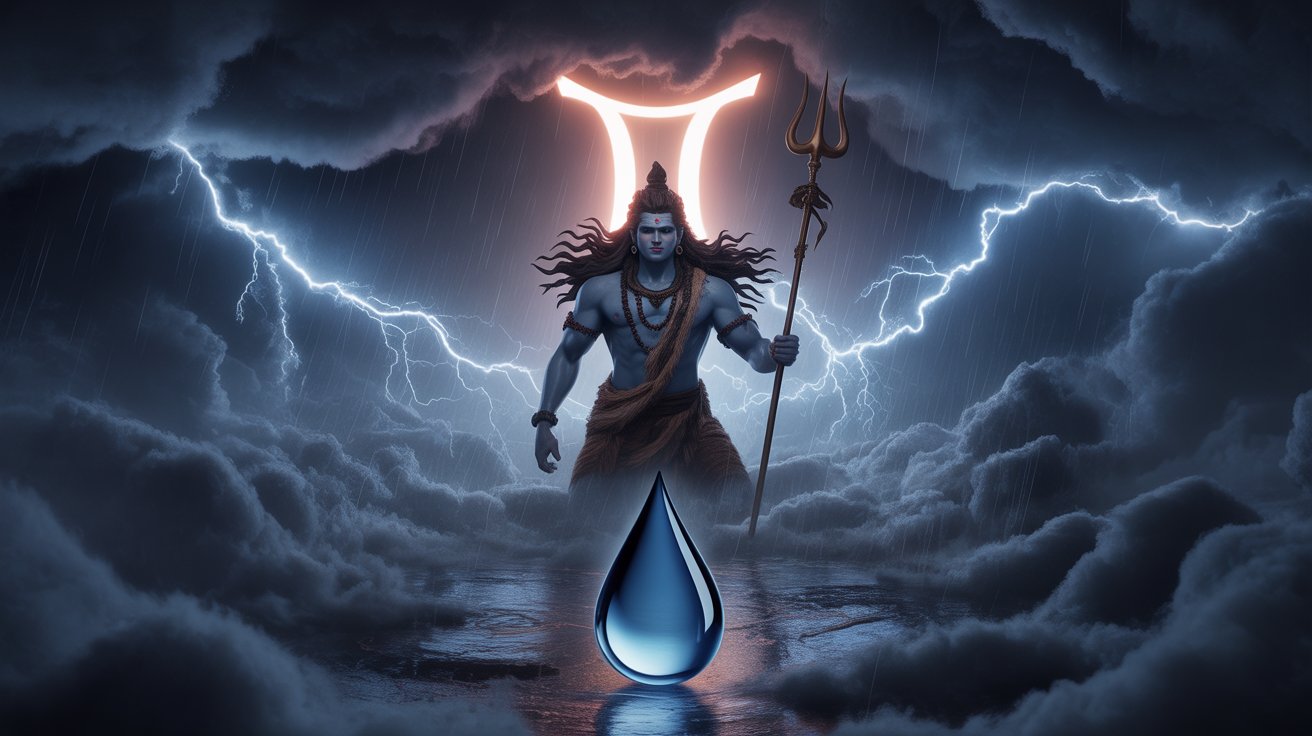
A Nakshatra ruled by destruction, yet responsible for emotional rebirth — this is the paradox of Ardra Nakshatra. It is the storm that breaks structures not out of cruelty, but to force transformation through truth. As with any Nakshatra, these qualities describe tendencies across thousands of charts — full conclusions require the complete horoscope including Lagna, Dasha, and planetary aspects.
If you are not sure about your nakshatra use this nakshatrafinder tool for free of cost.
QUICK FACTS TABLE
| Nakshatra number | 6 of 27 |
|---|---|
| Degree range | 06°40′ – 20°00′ Gemini |
| Zodiac sign | Gemini |
| Ruling planet | Rahu — because Ardra represents chaos, disruption, and intense transformation, all domains governed by Rahu’s boundary-breaking nature |
| Presiding deity | Rudra — “the howler”, a fierce form of Shiva representing destruction and emotional release |
| Symbol | Teardrop — symbolizes sorrow, purification, and emotional catharsis |
| Gana | Manushya — “human”, indicating moral struggle and experiential learning |
| Animal symbol | Dog (Yoni class: male) |
| Body part ruled | Shoulders, lungs, nervous system |
| Element | Vayu (air) |
| Quality (Guna) | Chara (movable) |
| Dosha | Vata — requires grounding, warm, and stabilizing diet |
| Motivation (Purushartha) | Kama — desire, emotional experience, and sensory engagement |
MYTHOLOGY — The Rudra myth that explains Ardra energy
Rudra, the fierce form of Shiva, appears in the Vedic texts not as a calm ascetic but as a howling force of destruction. In one well-known episode, Rudra unleashes storms and disease upon the world when disrespected by the gods, forcing them to acknowledge his power. His anger is not random — it arises when natural order is violated. This makes Rudra a deity who destroys not out of malice, but as a corrective force.
The outcome of Rudra’s destruction is always purification. After chaos, healing follows, because Rudra is also the divine physician who restores balance once excess has been removed. This dual role — destroyer and healer — defines Ardra’s core mechanism: breakdown precedes clarity. The Nakshatra operates by forcing confrontation with truth, often through emotional intensity or sudden disruption.
Rigveda 2.33 (https://www.sacred-texts.com/hin/rigveda/rv02033.htm) describes Rudra as “the mightiest of the mighty, the healer of diseases” — this means destruction and healing are not separate phases but part of the same process. The same force that creates suffering also removes its root cause. This defines Ardra’s relationship with pain: it is transformative rather than purely negative.
In chart readings, natives with Moon in Ardra often display emotional intensity followed by sudden clarity — particularly when Rahu dasha activates or when Mars aspects the Moon. I have observed that crises in their life are rarely meaningless; they act as turning points that restructure the native’s direction completely.
SYMBOL & DEEPER MEANING — What the Teardrop reveals that other articles miss
The symbol of Ardra is the teardrop, derived from the Sanskrit root “ardra”, meaning “moist,” “wet,” or “soaked.” This refers not just to physical tears, but to emotional saturation — a state where feelings reach their peak intensity. Unlike dry or suppressed emotions, Ardra represents emotional overflow that demands release.
In Vedic psychology, tears are not weakness but a form of purification. The teardrop connects to the lungs and breath, which are governed by the Vayu element — indicating that emotional processing in Ardra occurs through release and movement. This is why natives often feel lighter after emotional expression, because the system is designed to discharge pressure rather than contain it.
What most articles miss: Most descriptions frame the teardrop as sadness — but the more precise Vedic reading is emotional cleansing. Ardra is not just about suffering; it is about reaching the threshold where truth cannot be suppressed. The Ardra personality operates at the point where illusion breaks and reality becomes unavoidable.
The Ardra personality — what they show and what they hide
LAYER 1 — SURFACE TRAITS
EMOTIONAL INTENSITY
They experience emotions deeply and visibly, often reacting strongly to life events. This intensity is rooted in Rudra because he represents the raw, unfiltered expression of feeling rather than suppression. This becomes most visible during Rahu dasha or when Moon is afflicted by Mars or Saturn.
TRUTH-SEEKING NATURE
They have a strong urge to uncover hidden truths, even when uncomfortable. This is rooted in Rahu because Rahu breaks illusions and pushes the mind toward unconventional or hidden knowledge. This trait intensifies when Rahu is placed in the 1st, 8th, or 10th house.
CRISIS-DRIVEN GROWTH
They tend to evolve through difficult experiences rather than smooth progress. This is rooted in Rudra because transformation in this Nakshatra happens through destruction of old structures. This pattern becomes strongest during Rahu or Ketu dasha transitions.
INTELLECTUAL RESTLESSNESS
They constantly seek new ideas, often shifting perspectives rapidly. This is rooted in Gemini’s influence combined with Rahu, because it creates a mind that rejects fixed conclusions. This increases when Mercury is conjunct Rahu or Moon.
UNCONVENTIONAL THINKING
They question norms and often challenge societal expectations. This is rooted in Rahu because it operates outside traditional boundaries and rejects conformity. This becomes prominent when Rahu influences the 3rd or 9th house.
Practitioner Observation:
In chart readings, Ardra Moon natives most visibly display emotional intensity when Rahu dasha begins — I have seen sudden life upheavals followed by complete psychological shifts. Across multiple horoscopes, a pattern of “breakdown before breakthrough” appears when Mars aspects the Moon in Ardra.
LAYER 2 — SHADOW TRAITS
EMOTIONAL VOLATILITY
They may swing between emotional extremes, reacting impulsively in stressful situations. This pattern arises because Rahu amplifies the Moon’s sensitivity, especially in an air sign like Gemini. Practicing structured breathing techniques stabilizes this pattern.
DESTRUCTIVE IMPULSES
They may sabotage relationships or opportunities during emotional overwhelm. This arises because Rudra energy destroys without pause when triggered. Conscious delay before reaction helps interrupt this cycle.
OBSESSION WITH CONTROL
They may try to control outcomes after experiencing chaos. This arises because Rahu creates anxiety around uncertainty and loss of control. Grounding practices like routine-building reduce this tendency.
MENTAL OVERLOAD
They may overthink to the point of exhaustion. This arises because Gemini amplifies Rahu’s tendency toward excessive mental activity. Reducing information intake and digital detox can help restore balance.
Ardra Nakshatra male natives — how the energy expresses differently
Ardra male natives often express intensity through action rather than emotion. They tend to take on challenging environments or crises willingly, because Rudra energy in masculine expression seeks confrontation rather than avoidance. This can make them appear fearless, but internally they process deep emotional layers that are rarely shared openly.
Physically, they may have sharp features, prominent shoulders, or a restless body language due to Vayu dominance. Career patterns often involve high-pressure environments like business, technology, or crisis management roles. Their relationship with authority can be rebellious, especially when Rahu is strong, and father dynamics may involve conflict or distance.
Ardra Nakshatra female natives — energy, ambition, and relational patterns
Ardra female natives often display emotional intelligence combined with strong independence. They do not conform easily to traditional expectations, because Rahu pushes them toward self-defined identity rather than societal roles. Their ambition is not always linear — it evolves through phases of disruption and reinvention.
In relationships, they seek emotional honesty rather than superficial harmony. This can create tension in traditional setups, because they are unwilling to suppress truth for stability. In domestic life, they often balance nurturing with strong individuality, refusing to lose identity within roles.
In chart readings, I have observed Ardra Moon in female charts produces sudden relationship changes during Rahu dasha — particularly when Venus is afflicted. These shifts are rarely random; they reflect a deeper need for authenticity rather than compromise.
Ardra Nakshatra padas — how each quarter changes the energy
Pada 1 (06°40′–10°00′ Gemini)
Pada 1 falls in Sagittarius Navamsa, ruled by Jupiter. Jupiter expands Ardra’s intensity into philosophical exploration, making these natives seekers of higher truth rather than just emotional expression. They differ from other padas by their moral questioning and desire for meaning. This pada excels in teaching, philosophy, and guidance roles because Jupiter directs Rudra’s destruction toward wisdom.
Pada 2 (10°00′–13°20′ Gemini)
Pada 2 falls in Capricorn Navamsa, ruled by Saturn. Saturn grounds Ardra’s chaos into structured effort, creating individuals who endure hardship with discipline. They differ by their ability to handle pressure without emotional breakdown. This pada excels in corporate, administrative, or long-term projects because Saturn stabilizes Rahu’s volatility.
Pada 3 (13°20′–16°40′ Gemini)
Pada 3 falls in Aquarius Navamsa, ruled by Saturn. Here, Ardra’s energy becomes socially oriented, focusing on systems, innovation, and collective change. They differ through their futuristic thinking and detachment from personal emotion. This pada excels in technology and social reform because Saturn channels Rahu toward systemic transformation.
Pada 4 (16°40′–20°00′ Gemini)
Pada 4 falls in Pisces Navamsa, ruled by Jupiter. Jupiter softens Rudra’s intensity into compassion and emotional depth, making these natives more sensitive and intuitive. They differ by their spiritual inclination and emotional receptivity. This pada excels in healing, counseling, or creative fields because Jupiter converts destruction into empathy.
Careers where Ardra energy gives a natural edge
CRISIS MANAGEMENT
Ardra natives excel here because Rudra governs destruction and recovery, making them naturally suited to high-pressure breakdown situations. Real-world roles include disaster response coordinators, emergency planners, or turnaround specialists in failing businesses.
PSYCHOLOGY & THERAPY
They are drawn to emotional depth because the teardrop symbol represents catharsis and healing through confronting pain. This manifests as psychologists, trauma therapists, or counselors dealing with intense emotional cases.
TECHNOLOGY & AI
Rahu governs innovation and disruption, making Ardra natives natural in cutting-edge fields. They often work as software engineers, cybersecurity analysts, or AI researchers who challenge conventional systems.
INVESTIGATIVE ROLES
They seek truth beneath the surface because Rahu breaks illusions and exposes hidden layers. This appears as detectives, investigative journalists, or forensic analysts.
SURGERY & MEDICAL FIELDS
Rudra’s destructive-healing duality makes them capable of cutting away what is harmful to restore balance. This is seen in surgeons, especially those dealing with emergency or trauma cases.
STOCK MARKET & TRADING
Rahu governs risk-taking and volatility, aligning with markets driven by uncertainty. These natives often thrive as traders or analysts dealing with high-risk financial environments.
UNEXPECTED CAREER: FILM DIRECTION
Ardra natives often excel in storytelling because they understand emotional extremes and transformation. They may become directors or writers who portray raw human experiences and psychological depth.
Entrepreneurship
Ardra favors independent paths because Rahu resists traditional structures and thrives in uncertainty. These natives often succeed in startups or unconventional ventures where risk and rapid change are constant. However, stability may come only after multiple failures, because growth occurs through trial and breakdown cycles.
[→ Internal link: Moon in Gemini — Career Implications]
How Ardra natives love — and what they actually need in a partner
Ardra natives need emotional honesty above all else. This is because Rudra destroys illusion, making superficial relationships unsustainable for them. They require partners who can handle intensity rather than avoid it.
In early relationships, they may experience instability or sudden changes. This happens because Rahu matures later in life, often bringing clarity only after multiple emotional lessons. Long-term stability usually improves after age 32–36 when Rahu’s energy stabilizes.
Recurring challenges include emotional outbursts or sudden detachment. This arises because Rahu amplifies the Moon’s fluctuations, creating unpredictable emotional patterns. Without awareness, this can lead to cycles of closeness and distance.
In composite chart readings, Ardra Moon often shows intense karmic bonds when paired with Swati or Shatabhisha Nakshatra — particularly when Rahu is strongly placed. These relationships tend to be transformative but not always stable.
Which Nakshatras are truly compatible with Ardra — and the Vedic logic behind each
SWATI (Compatible)
Both are ruled by Rahu, creating strong planetary alignment and mutual understanding. Their Manushya Gana match and favorable Tara Bala (5th relationship) support growth through shared independence.
SHATABHISHA (Compatible)
Rahu rulership creates deep intellectual and emotional resonance. Their Vayu element alignment and friendly planetary relationship promote shared innovation and unconventional thinking.
ASHWINI (Compatible)
Ashwini’s Ketu complements Ardra’s Rahu, forming a karmic axis of balance. Their Deva-Manushya Gana combination works because Ashwini brings healing where Ardra brings transformation.
ROHINI (Challenging)
Rohini’s Moon rulership seeks stability, while Ardra’s Rahu brings disruption. Their incompatible Yoni (Serpent vs Dog) and conflicting emotional needs create tension.
UTTARA PHALGUNI (Challenging)
Sun rulership in Uttara Phalguni clashes with Rahu’s rebellious nature. Their Gana mismatch and differing life priorities often lead to power struggles.
[→ Internal link: Ardra Nakshatra Compatibility — Full Chart]
Health predispositions of Ardra — and why classical texts focus on the lungs and nervous system
Ardra spans Gemini, which governs the shoulders, lungs, and nervous system in Kalapurusha (cosmic body). Within Gemini, Ardra occupies the central zone associated with breath and neural response. Rahu as ruling planet creates irregular patterns, making these systems more sensitive to imbalance.
Classical texts associate a tendency toward respiratory issues, anxiety disorders, and nervous tension — more pronounced when Rahu afflicts the Moon or Mercury. Conditions like asthma, chronic stress, or insomnia may appear as predispositions observed when planetary afflictions are present. These are not certainties but patterns seen across charts.
Ardra is Vata-dominant because of its Vayu element and Rahu’s airy nature. This suggests a need for grounding foods — warm, oily, and less dry — to balance internal instability. According to Ayurveda (https://www.niam.gov.in), Vata imbalance is managed through routine, warmth, and stable diet patterns.
What most practitioners overlook: Ardra natives may experience digestive disturbances unrelated to lungs. This happens because nervous system imbalance directly affects gut function through the Vata mechanism.
Disclaimer: This section reflects classical Jyotish associations and should not replace medical consultation. Astrological health indicators are predispositions, not diagnoses.
Notable Ardra Nakshatra personalities — and what their lives reveal
Angelina Jolie
Moon in Ardra, birth data from AstroDatabank (Rodden Rating: AA): https://www.astro.com/astro-databank/Jolie,_Angelina
Her life reflects intense emotional experiences and transformation, including humanitarian work after personal crises — a classic Ardra pattern of pain leading to purpose.
Kanye West
Moon in Ardra, birth data from AstroDatabank (Rodden Rating: AA): https://www.astro.com/astro-databank/West,_Kanye
His unpredictable behavior and emotional expression demonstrate Rahu-driven intensity and unconventional thinking.
Prince
Moon in Ardra, birth data from AstroDatabank (Rodden Rating: AA): https://www.astro.com/astro-databank/Prince_(musician)
His artistic originality and boundary-breaking music reflect Rahu’s influence in creative expression.
Marilyn Monroe
Moon in Ardra (probable), placement likely but time-dependent; cross-reference recommended: https://www.astro.com/astro-databank/Monroe,_Marilyn
Her life reflects emotional vulnerability and public intensity — a manifestation of the teardrop symbol.
Ardra Nakshatra remedies — what works and the astrological logic behind each
MANTRA
ॐ नमः शिवाय
Om Namah Shivaya
Translation: “I bow to Shiva, the supreme transformer.”
- 108 repetitions daily using Rudraksha mala
- Best time: early morning (Brahma Muhurta) or Mondays
- This mantra works because Rudra is a fierce form of Shiva, and this chant invokes his calming, transformative aspect. It stabilizes the destructive impulse by aligning it with conscious awareness.
GEMSTONE
- Primary: Hessonite (Gomed)
- Finger: Middle finger, silver metal
- Should wear: when Rahu is beneficial (e.g., Taurus, Gemini ascendant)
- Avoid: if Rahu is in 6th, 8th, 12th or heavily afflicted
This works because Hessonite strengthens Rahu’s positive expression — giving direction to chaos rather than suppression. It helps channel Ardra energy into innovation instead of instability.
COLORS / SEVA / PRACTICES
- Favor: Dark blue, smoky shades — align with Rahu’s frequency
- Avoid: Bright red — may intensify emotional volatility
- Seva: Work in crisis centers, hospitals, or mental health support
- Best day: Saturday or Wednesday
- Fasting: Light fasting on Saturdays stabilizes Rahu
This works because Rahu responds to discipline and grounding practices rather than suppression.
Frequently asked questions about Ardra Nakshatra
Q1: What does Moon in Ardra Nakshatra mean?
Moon in Ardra Nakshatra indicates emotional intensity and transformation-driven life experiences. This happens because Rahu amplifies the Moon’s sensitivity while Rudra drives emotional release and truth-seeking. The result varies when supported by chart factors such as Mercury strength or Rahu placement.
Q2: Is Ardra Nakshatra good for marriage?
Ardra Nakshatra can support marriage when emotional maturity is present. This is because Rahu creates instability early but evolves toward clarity over time. Outcomes depend on factors like Venus strength and compatibility with partner’s Nakshatra.
Q3: What are Ardra Nakshatra female characteristics?
Ardra females are independent, emotionally intelligent, and truth-driven in relationships. This arises because Rahu pushes them beyond societal norms while Rudra demands authenticity. Expression varies when supported by Venus placement and Moon strength.
Q4: Which Nakshatra is compatible with Ardra?
Swati, Shatabhisha, and Ashwini are commonly compatible with Ardra Nakshatra. This compatibility arises from Rahu alignment, Gana matching, and favorable Tara Bala relationships. Full compatibility depends on Nadi, Yoni, and planetary positions.
Q5: What is Ardra Nakshatra pada 2?
Ardra pada 2 falls in Capricorn Navamsa and is ruled by Saturn. This gives structure and discipline to Ardra’s otherwise chaotic energy. It often produces individuals who succeed through persistence when supported by strong Saturn placement.
Q6: What is the difference between Bharani and Ardra Nakshatra?
• Bharani = controlled transformation — it contains and processes energy
• Ardra = explosive transformation — it breaks and releases energy
• Krittika = refining transformation — it purifies through fire
Note: Nakshatra characteristics describe tendencies, not certainties — the full natal chart including Lagna, planetary aspects, and current Dasha must be considered for individual readings.
Ardra Nakshatra — its place in the soul’s journey through the 27
Ardra represents the stage where illusion collapses and truth emerges. In the evolutionary arc, it is the storm that disrupts stability to force deeper awareness. This Nakshatra does not allow superficial existence — it demands transformation.
Bharani completes the phase of containment and preparation. Ardra begins the phase of destruction and emotional release, breaking what can no longer hold. This transition is necessary because growth requires the removal of outdated structures.
The soul lesson of Ardra is acceptance of chaos as part of transformation. It teaches that destruction is not the end but a necessary phase of renewal. Through this, the native learns resilience and truth.
Bharani embodies controlled containment of life-force — it completes the phase of internal preparation. Ardra then opens with explosive emotional release — it begins the phase of breakdown and truth exposure. Rohini takes this energy and stabilizes it into growth and creation. This transition from Bharani through Ardra to Rohini mirrors emotional breakdown leading to psychological rebirth and stability.