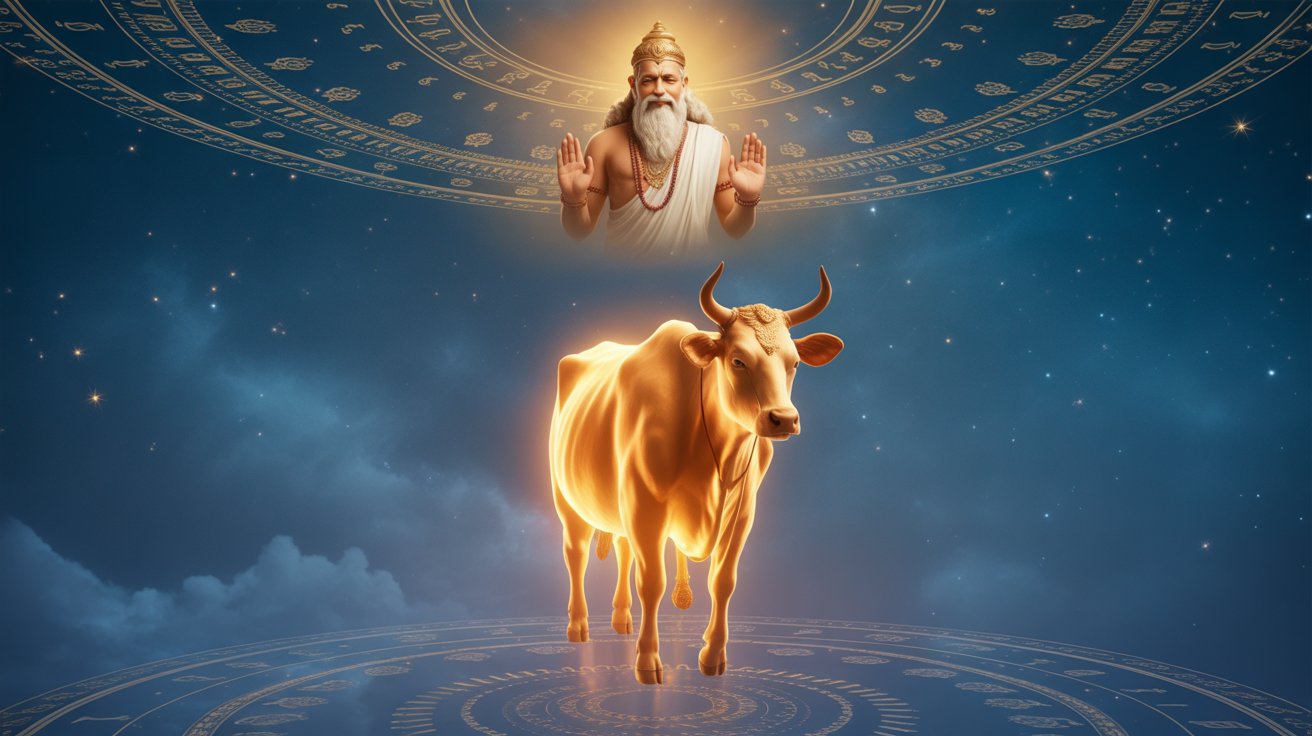
When the gods sought nourishment that sustains both body and dharma, they invoked a force not of aggression but of quiet growth — this is the essence of Pushya. It is the only Nakshatra explicitly called nourishing in classical texts, yet it sits in Saturn’s domain, creating a paradox of discipline feeding abundance. As with any Nakshatra, these qualities describe tendencies across thousands of charts — full conclusions require the complete horoscope including Lagna, Dasha, and planetary aspects.
If you are not sure about your nakshatra use this nakshatrafinder tool for free of cost.
Quick Facts — Pushya Nakshatra
| Attribute | Details |
|---|---|
| Nakshatra number | 8 of 27 |
| Degree range | 03°20′ – 16°40′ Cancer |
| Zodiac sign | Cancer |
| Ruling planet | Saturn (Shani) — because sustained nourishment requires discipline, patience, and time-bound growth |
| Presiding deity | Brihaspati — the Guru of the gods, meaning “lord of sacred wisdom and expansion” |
| Symbol | Cow’s udder / lotus — nourishment, protection, and spiritual feeding |
| Gana | Deva — “divine”, indicating sattvic, duty-oriented expression |
| Animal symbol | Goat (Yoni class: male) |
| Body part ruled | Chest, lungs, and breasts |
| Element | Jala (water) |
| Quality (Guna) | Chara (movable) |
| Dosha | Kapha — requires light, warm, digestion-supporting foods |
| Motivation (Purushartha) | Dharma — duty, righteousness, cosmic order |
The Brihaspati myth that explains Pushya energy
In the Puranic narratives, Brihaspati, the Guru of the Devas, withdraws his guidance when Indra becomes arrogant after victory over the Asuras. Without Brihaspati’s wisdom, the Devas lose their strength and become vulnerable, demonstrating that power without nourishment of wisdom collapses. Later, when Brihaspati returns, he does not give them weapons — he restores their understanding, discipline, and alignment with dharma.
This myth reveals the core mechanism of Pushya: it nourishes through correction, not indulgence. Brihaspati does not feed blindly; he feeds what aligns with cosmic law, which is why Pushya natives often support others but only within structured boundaries. The nourishment here is conditional — it strengthens what is worthy and withdraws from what is excessive or ego-driven.
Rigveda 2.23.1 describes Brihaspati as “the one who opens the path and gives wisdom through sacred speech” — this means Pushya energy nourishes not just physically, but intellectually and spiritually. The phrase implies that growth comes through guidance and correction, not comfort alone. This defines Pushya natives as those who feed growth through structure, teaching, and responsibility.
In chart readings, I have observed Pushya Moon natives take on caretaker roles naturally — particularly when Saturn aspects the Moon or during Saturn dasha. Across multiple horoscopes, a pattern appears where they become the “support system” of the family, even at personal cost, especially when Cancer is emphasized in the chart.
What the cow’s udder reveals that other articles miss
The word “Pushya” comes from the Sanskrit root “पोषण (Poshana)”, meaning nourishment, growth, and sustaining life. Unlike symbols of creation, this Nakshatra does not initiate life — it sustains and develops it after birth. This distinction is critical because Pushya is not about starting something new, but about making it stable and enduring.
The cow’s udder as a symbol represents controlled nourishment — milk flows only when needed and in appropriate measure. In Vedic culture, the cow is sacred not just because it gives, but because it gives responsibly and consistently. This reflects how Pushya operates: steady, disciplined, and protective nourishment that supports long-term growth.
What most articles miss: Most descriptions say Pushya is “caring and nurturing,” but the deeper Vedic reading is conditional nourishment governed by Saturn. Pushya natives do not simply give — they evaluate, structure, and sustain. They are not emotional caregivers alone; they are strategic sustainers of life systems.
The Pushya personality — what they show and what they hide
STRUCTURED CAREGIVING
They take responsibility for others and often become the pillar people rely on. This caregiving is rooted in Brihaspati’s wisdom combined with Saturn’s discipline because nourishment here must be guided and controlled. This becomes strongest during Saturn dasha or when Moon is in the 10th house.
QUIET AUTHORITY
They rarely demand attention but naturally command respect in groups. This authority is rooted in Saturn’s mature energy because influence comes from consistency rather than display. It intensifies when Saturn is well-placed or aspects the Moon.
EMOTIONAL RESTRAINT
They feel deeply but do not express emotions easily. This restraint arises because Saturn governs emotional boundaries in a watery Cancer sign, preventing emotional overflow. It becomes more visible during Saturn or Rahu dasha.
SERVICE-ORIENTED MINDSET
They prefer roles where they can support systems rather than dominate them. This is rooted in Brihaspati’s role as Guru because teaching and guiding are their natural expressions. It strengthens when Jupiter is strong in the chart.
LONG-TERM THINKING
They prioritize stability over quick gains. This trait comes from Saturn’s slow-moving nature because growth must be sustained, not rushed. It intensifies when Saturn occupies angular houses.
Practitioner insight:
In chart readings, Pushya Moon natives most visibly display structured caregiving when Saturn aspects the Moon — I have seen this pattern strongly during Saturn return periods where responsibilities suddenly increase.
Shadow traits
EMOTIONAL SUPPRESSION
They bottle emotions until it affects mental peace. This pattern arises because Saturn restricts the Moon’s natural emotional flow in Cancer. Practicing journaling or emotional expression helps release pressure.
OVER-RESPONSIBILITY
They take on more than they should, often neglecting themselves. This happens because Brihaspati expands duty while Saturn enforces it. Setting boundaries is essential to avoid burnout.
CONTROL ISSUES
They may try to control how others grow or behave. This arises because nourishment here is conditional and structured. Practicing trust and delegation reduces this tendency.
DELAY IN PERSONAL HAPPINESS
They often prioritize duty before personal joy. This is rooted in Saturn’s karmic sequencing where rewards come after effort. Conscious scheduling of personal time helps balance this.
Pushya Nakshatra male natives — how the energy expresses differently
Pushya male natives often become providers early in life, taking on family responsibilities sooner than expected. Their identity is tied to duty and stability rather than personal ambition alone. They are less impulsive compared to other Cancer placements because Saturn enforces discipline over emotion.
Physically, they may have a strong chest or grounded posture, reflecting Saturn’s structural influence. Career-wise, they prefer stable, long-term roles such as administration, government, or structured business. Their relationship with the father may involve responsibility or expectation rather than emotional bonding.
Pushya Nakshatra female natives — energy, ambition, and relational patterns
Pushya female natives balance nurturing with strength, often becoming the emotional and practical backbone of their family. Their ambition is subtle — they grow steadily rather than aggressively. They value security and long-term stability in both career and relationships.
In relationships, they may give more than they receive, especially in early life. Motherhood often amplifies their natural nurturing tendencies but can also create emotional overload if boundaries are not maintained. Society may expect softness, but their Saturn influence gives them resilience and authority.
Practitioner observation:
In female charts, Pushya Moon with Saturn aspect produces women who carry family burdens silently — especially during Saturn dasha, where responsibility peaks.
Pushya Nakshatra padas — how each quarter changes the energy
Pada 1 (03°20′–06°40′ Cancer, Leo Navamsa, ruled by Sun):
This pada adds leadership to nurturing energy. The Sun’s influence creates individuals who guide others with authority, often in teaching or administrative roles. They stand out due to confidence compared to other Pushya natives.
Pada 2 (06°40′–10°00′ Cancer, Virgo Navamsa, ruled by Mercury):
This pada brings analytical thinking to caregiving. Mercury refines the nurturing into practical systems, making these natives excellent planners and advisors. They excel in detail-oriented service roles.
Pada 3 (10°00′–13°20′ Cancer, Libra Navamsa, ruled by Venus):
This pada softens the Saturn influence with harmony and balance. Venus adds relationship focus, making these natives skilled in diplomacy and emotional support. They excel in partnerships and counseling roles.
Pada 4 (13°20′–16°40′ Cancer, Scorpio Navamsa, ruled by Mars):
This pada intensifies emotional depth and resilience. Mars adds inner strength and survival instinct, making these natives powerful in crisis situations. They differ from others by their ability to handle emotional extremes.
Careers where Pushya energy gives a natural edge
TEACHER / GURU
They naturally guide others because Brihaspati governs wisdom and structured learning. This makes them effective as school teachers, professors, or spiritual instructors who shape long-term growth.
HEALTHCARE / CARETAKER ROLES
They support healing systems because the cow’s udder symbol represents nourishment and protection. Roles like nurse, therapist, or nutrition advisor suit their steady caregiving nature.
ADMINISTRATION / GOVERNMENT
They thrive in structured environments because Saturn rules discipline and hierarchy. This often manifests as government officers, compliance managers, or institutional leaders.
FINANCIAL PLANNING
They manage resources conservatively because Saturn favors long-term stability over risk. Roles include financial advisor, wealth planner, or auditor.
AGRICULTURE / FOOD INDUSTRY
They work well with nourishment systems because Pushya is directly linked to feeding and growth cycles. This can show as farming, dairy industry, or food supply chain management.
SPIRITUAL COUNSELING
They guide others through life challenges because Brihaspati represents dharma and higher knowledge. This appears in roles like astrologer, counselor, or life coach.
UNEXPECTED CAREER: DEFENSE LOGISTICS
They may work behind the scenes in security or defense systems because Saturn governs structure and reliability. This includes supply chain roles in military or emergency management sectors.
Entrepreneurship:
Pushya natives are better in structured or long-term businesses rather than high-risk startups. Saturn prefers steady growth, so industries like education, healthcare, or real estate suit them more than volatile ventures. They succeed when they build systems that sustain over time rather than chasing quick gains.
[→ Internal link: Moon in Cancer — Career Implications]
How Pushya natives love — and what they actually need in a partner
Pushya natives need emotional stability and reliability in a partner. This is because Saturn governs commitment while Brihaspati seeks dharmic alignment, meaning relationships must have purpose and structure. They are not drawn to chaos; they prefer predictability and long-term security.
In early relationships, they may over-give and take responsibility for the partner’s growth. Over time, Saturn matures their approach, making them more selective and boundary-driven. This shift is often seen after Saturn return or during Saturn dasha.
Their main challenge is emotional suppression, where they expect partners to understand without expression. This arises because Saturn restricts the Moon’s emotional flow in Cancer. Learning to communicate feelings openly becomes essential for relationship stability.
Practitioner insight:
In composite chart readings, Pushya Moon often shows imbalance when paired with Ashlesha Moon natives — especially when Saturn influences the Moon, creating control vs. emotional intensity dynamics.
Which Nakshatras are truly compatible with Pushya — and the Vedic logic behind each
ANURADHA (Highly Compatible)
Both share Saturn influence, creating mutual understanding of discipline and loyalty. Their Deva-Manushya compatibility works well, and planetary friendship between Saturn and Jupiter supports long-term stability.
UTTARA PHALGUNI (Compatible)
This pairing works because both prioritize dharma and responsibility. Their Gana compatibility and supportive Sun-Jupiter relationship create balance between structure and warmth.
REVATI (Compatible)
Revati’s nurturing complements Pushya’s structured care. Their Deva Gana alignment and favorable Tara Bala create emotional harmony and mutual support.
ASHLESHA (Challenging)
Ashlesha’s emotional intensity clashes with Pushya’s restraint. Their Nadi differences and Mercury-Saturn tension create misunderstandings in emotional expression.
MAGHA (Challenging)
Magha’s authority-driven nature conflicts with Pushya’s quiet discipline. Sun-Saturn opposition and Gana mismatch can lead to ego clashes and power struggles.
[→ Internal link: Pushya Nakshatra Compatibility — Full Chart]
Health predispositions of Pushya — and why classical texts focus on the chest
Pushya lies in Cancer, which governs the chest, lungs, and breasts, and its placement in the middle of the sign emphasizes nourishment and respiration. The Moon rules Cancer, but Saturn’s influence restricts flow, creating a tendency toward congestion or stagnation. This combination explains why this Nakshatra is linked to respiratory and груд-related sensitivity.
Classical texts associate a predisposition toward conditions like chest congestion, asthma tendencies, or breast-related issues — more pronounced when Saturn afflicts the Moon or during Saturn dasha. Emotional suppression may also manifest physically as tightness in the chest. These patterns are tendencies, not certainties, and depend on overall chart strength.
Pushya is Kapha-dominant because of its watery Cancer base combined with Saturn’s slowing influence. Diet should include warm, light, and digestion-supporting foods while avoiding excessive dairy or cold items. According to Ayurveda principles (Ministry of AYUSH), balancing Kapha requires movement, warmth, and routine.
What most practitioners overlook:
Pushya natives may experience digestive issues linked to emotional suppression, even though the Nakshatra is not directly associated with the stomach. This connection appears in charts where Moon and Saturn interact strongly.
Disclaimer:
This section reflects classical Jyotish associations and should not replace medical consultation. Astrological health indicators are predispositions, not diagnoses.
Notable Pushya Nakshatra personalities — and what their lives reveal
Barack Obama
Moon in Pushya, birth data from AstroDatabank (Rodden Rating: AA): https://www.astro.com/astro-databank/Obama,_Barack
His leadership reflects structured authority and calm guidance, aligning with Saturn’s disciplined nourishment.
Dalai Lama
Moon in Pushya, birth data from AstroDatabank (Rodden Rating: AA): https://www.astro.com/astro-databank/Dalai_Lama
His life demonstrates spiritual nourishment and teaching, a direct expression of Brihaspati’s energy.
Princess Diana
Moon in Pushya, birth data from AstroDatabank (Rodden Rating: AA): https://www.astro.com/astro-databank/Diana,_Princess_of_Wales
Her nurturing public image and emotional restraint reflect Pushya’s caregiving combined with inner struggle.
Probable Example: Jeff Bezos
Moon in Pushya for most of his birth date — placement likely but time-dependent; cross-reference recommended. His long-term business vision reflects Saturn’s structured growth principle.
Pushya Nakshatra remedies — what works and the astrological logic behind each
MANTRA
ॐ बृं बृहस्पतये नमः
Om Brim Brihaspataye Namah
Translation: “I bow to Brihaspati, the divine teacher and nourisher of wisdom.”
- Chant 108 times daily, especially on Thursdays at sunrise
- Use a Tulsi mala for best results
This remedy works because Brihaspati governs wisdom and nourishment — invoking him aligns Pushya energy with dharma and balanced growth.
GEMSTONE
- Yellow Sapphire (Pukhraj) in gold on index finger
- Suitable for strong Jupiter charts (Sagittarius/Pisces Lagna)
- Avoid if Jupiter is debilitated or afflicted
This remedy works because Jupiter is the deity of Pushya — strengthening it enhances guidance, wisdom, and stability.
COLORS & LIFESTYLE
- Favor: Yellow, cream, light blue — supports Jupiter and calming energy
- Avoid: Dark grey/black excessively — may amplify Saturn heaviness
- Seva: Serve in food distribution or teaching roles
- Best day: Thursday morning
- Fasting: Light fast on Thursdays with sattvic food
This works because Pushya thrives on nourishment aligned with dharma — giving food or knowledge activates its highest expression.
Frequently asked questions about Pushya Nakshatra
Q1: What does Moon in Pushya Nakshatra mean?
Moon in Pushya Nakshatra indicates a nurturing, disciplined, and responsibility-driven emotional nature. This occurs because Saturn restricts the Moon while Brihaspati guides it toward dharma. The result varies depending on aspects and dasha, especially Saturn’s influence.
Q2: Is Pushya Nakshatra good for marriage?
Pushya Nakshatra is generally considered supportive for marriage due to its stability and commitment. This is because Saturn promotes long-term bonds while Brihaspati ensures dharmic alignment. However, emotional expression may need conscious effort depending on Moon afflictions.
Q3: What are Pushya Nakshatra female characteristics?
Pushya females are nurturing, responsible, and emotionally resilient. This comes from the combination of Cancer’s caregiving nature and Saturn’s discipline. Their experience varies when influenced by planetary aspects like Saturn or Venus.
Q4: Which Nakshatra is compatible with Pushya?
Pushya is most compatible with Anuradha, Revati, and Uttara Phalguni Nakshatras. This is due to shared dharmic values, Gana compatibility, and supportive planetary relationships. Compatibility still depends on full chart matching including Nadi and Tara factors.
Q5: What is the difference between Ashlesha and Pushya Nakshatra?
• Ashlesha = intense emotional binding — operates through control and depth
• Pushya = structured nourishment — operates through discipline and support
• Magha = ancestral authority — operates through lineage and power
Pushya Nakshatra — its place in the soul’s journey through the 27
Pushya represents the stage of sustained growth in the Nakshatra cycle, where life is no longer about initiation but about nourishment and stability. It follows the emotional intensity of earlier Nakshatras and brings structure to that energy. This is where the soul learns responsibility and long-term commitment.
Bharani represents containment and transformation, while Pushya shifts that into nourishment and expansion. This transition is critical because it moves from raw life force to structured growth. Without Pushya, energy would remain unrefined and unstable.
The soul lesson of Pushya is learning to give without losing oneself. It teaches balance between responsibility and self-care, between nourishment and control. This Nakshatra refines the ability to sustain life systems, not just create them.
Final comparison:
Bharani embodies transformation and containment — it completes the stage of holding life force. Pushya then opens with nourishment and discipline — it begins structured growth. Rohini takes this energy and expresses it as creation and beauty. This transition mirrors early human development from survival to growth to expression.