Govardhan Puja 2026: 9 or 10 November? Best Muhurat for Your City, Annakut Vidhi and Story
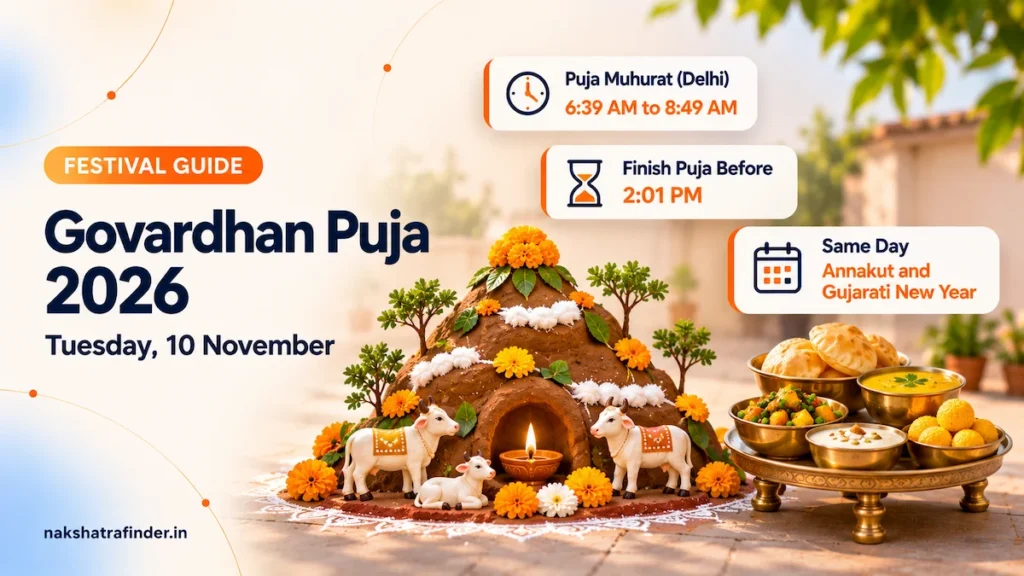
Govardhan Puja 2026 falls on Tuesday, 10 November, two days after Diwali this year. Kartik Shukla Pratipada begins at 12:32 PM on 9 November and ends at 2:01 PM on 10 November, so the 10th is the only day with Pratipada at sunrise. The morning muhurat in New Delhi is 6:39 AM to 8:49 AM, and the puja and Annakut offering should be finished before Pratipada ends at 2:01 PM.
The same day is Annakut, the Gujarati New Year (Bestu Varas) and Bali Pratipada or Diwali Padwa in Maharashtra. This guide gives the muhurat for 30 cities, explains the gap after Diwali, and sets out the puja and the story in order.
- Govardhan Puja 2026 at a glance
- Why 10 November and not 9 November
- Govardhan Puja muhurat in 30 cities
- Govardhan Puja vidhi at home
- Annakut: the mountain of food
- The story of Govardhan
- Gujarati New Year, Padwa and other observances
- Frequently asked questions
Govardhan Puja 2026 at a glance
| Detail | Govardhan Puja 2026 (New Delhi) |
|---|---|
| Date | Tuesday, 10 November 2026 |
| Pratipada tithi | 12:32 PM on 9 November to 2:01 PM on 10 November |
| Morning (pratahkal) muhurat | 6:39 AM to 8:49 AM |
| Finish the puja before | 2:01 PM, when Pratipada ends |
| Rahu Kaal | 2:48 PM to 4:09 PM |
| Moon’s nakshatra at sunrise | Vishakha |
| Same day | Annakut, Gujarati New Year (Vikram Samvat 2083), Bali Pratipada, Diwali Padwa |
| Next day | Bhai Dooj, Wednesday 11 November |
Why Govardhan Puja is on 10 November, not 9 November
Govardhan Puja normally falls the day after Diwali. In 2026 there is a one-day gap, and it comes from the length of Amavasya. Diwali Lakshmi Puja is on the evening of 8 November, when Amavasya covers Pradosh. Amavasya then runs on until 12:32 PM on 9 November, so sunrise on the 9th is still Amavasya; that day is Somvati Amavasya, a day for holy baths and charity. Pratipada is present at sunrise only on 10 November, and that is the day for Govardhan Puja and Annakut across India.
You will see 9 November on some websites. Those dates are usually calculated for North America, where Pratipada begins in the early hours of the 9th local time and is present at sunrise there. For India, the 10th is correct.
Because Pratipada ends at 2:01 PM, this year the whole puja belongs to the first half of the day. Families who usually set out the Annakut in the afternoon or evening should plan to complete the main offering by early afternoon.
Govardhan Puja 2026 muhurat in 30 cities
The muhurat below is pratahkal, the first fifth of the day after sunrise, which panchangs prefer for Govardhan Puja. If you cannot finish in this window, any time before 2:01 PM is acceptable, avoiding Rahu Kaal.
| City | Morning muhurat, 10 November |
|---|---|
| Delhi | 6:39 AM to 8:49 AM |
| Noida | 6:39 AM to 8:48 AM |
| Gurugram | 6:40 AM to 8:50 AM |
| Chandigarh | 6:45 AM to 8:53 AM |
| Amritsar | 6:54 AM to 9:01 AM |
| Ludhiana | 6:49 AM to 8:57 AM |
| Jammu | 6:56 AM to 9:03 AM |
| Dehradun | 6:39 AM to 8:47 AM |
| Jaipur | 6:42 AM to 8:53 AM |
| Jodhpur | 6:53 AM to 9:04 AM |
| Lucknow | 6:22 AM to 8:33 AM |
| Kanpur | 6:24 AM to 8:35 AM |
| Varanasi | 6:11 AM to 8:23 AM |
| Agra | 6:34 AM to 8:45 AM |
| Patna | 6:03 AM to 8:15 AM |
| Ranchi | 5:59 AM to 8:12 AM |
| Kolkata | 5:46 AM to 7:59 AM |
| Bhubaneswar | 5:53 AM to 8:07 AM |
| Guwahati | 5:37 AM to 7:49 AM |
| Bhopal | 6:31 AM to 8:43 AM |
| Indore | 6:36 AM to 8:49 AM |
| Raipur | 6:11 AM to 8:25 AM |
| Nagpur | 6:21 AM to 8:35 AM |
| Ahmedabad | 6:50 AM to 9:03 AM |
| Surat | 6:46 AM to 9:00 AM |
| Mumbai | 6:43 AM to 8:58 AM |
| Pune | 6:38 AM to 8:54 AM |
| Hyderabad | 6:18 AM to 8:34 AM |
| Bengaluru | 6:16 AM to 8:34 AM |
| Chennai | 6:05 AM to 8:24 AM |
Rahu Kaal on Tuesday falls in the mid-afternoon, from 2:48 PM to 4:09 PM in Delhi, which is after Pratipada ends anyway. For your own city’s Rahu Kaal on any day of the festival week, use the Rahu Kalam calculator.
Govardhan Puja vidhi at home
What you need
- Fresh cow dung (gobar) to shape the Govardhan hill, or clean clay or flour dough if cow dung is not available in your city
- Cotton, small sticks or straw, and flowers to decorate the hill, and small figures of cows, cowherds and Krishna
- Roli, rice, haldi, milk, curd, honey, ghee lamps and incense
- The Annakut dishes: as many vegetarian preparations as the family can make
Step by step
- Bathe early and clean the courtyard, the entrance or the puja corner.
- Shape a small hill, or a reclining human figure that represents Govardhan, from cow dung or clay. Many families give it a navel where a small earthen lamp or a bowl of milk, curd and honey is placed.
- Decorate it with flowers, cotton and small sticks for trees, and place the figures of cows, calves and Krishna around it.
- Inside the muhurat, light a lamp, offer roli, rice, flowers and water, and pour the milk, curd and honey into the navel.
- Walk around the hill seven times (parikrama) with water and grain in your hands, sprinkling a little as you go.
- Offer the Annakut, then do the aarti of Govardhan and Krishna.
- Worship the cows of the house or of a nearby gaushala with tilak, a garland and fresh grass or jaggery.
- Share the Annakut prasad with family, neighbours and anyone who visits.
A short prayer often recited is Govardhana Dharadhara Gokula Trana Karaka, Vishnu Bahu Krita Chchhaya Gavam Koti Prada Bhava, asking Govardhan, the protector of Gokul, to bless the household with cattle and plenty.
Annakut: the mountain of food
Annakut means “a mountain of grain”. In temples, especially in Mathura, Vrindavan, Nathdwara and the Swaminarayan and ISKCON temples, cooks prepare dozens or even hundreds of dishes and arrange them in tiers before the deity. The best-known form is Chhappan Bhog, 56 dishes, which tradition links to the seven days Krishna held up the hill without eating, eight meals a day for seven days.
At home the offering is simpler. A typical North Indian Annakut includes kadhi, bajra or rice, a mixed vegetable sabzi known as annakut ki sabzi made from every seasonal vegetable in the kitchen, puri, kheer, halwa and sweets. The point is abundance and sharing rather than a fixed menu, and the prasad is meant to be given away as widely as possible.
The story of Govardhan
The Bhagavata Purana tells how the cowherds of Vraj prepared a great yearly sacrifice for Indra, the god of rain. The young Krishna asked why. They depended, he said, on the Govardhan hill for grass, water and shelter for their cows, and on their own work, so the hill and the cows deserved their worship more than a distant god. The villagers agreed and offered their feast to Govardhan instead.
Indra was furious and sent storm clouds that poured rain on Vraj for seven days. Krishna lifted the whole hill on the little finger of his left hand and held it up like an umbrella, and every family and animal of the village sheltered beneath it. When the storm ended and Indra saw that not one cow had been lost, he came to Krishna and asked forgiveness. Krishna is called Giridhari, “the one who holds the mountain”, after this episode.
The festival’s message is close to the land: respect the hills, rivers, cattle and harvest that sustain life. That is why the puja centres on a model of the hill and on cows, and why devotees in Vraj walk the 21-kilometre parikrama of the real Govardhan hill on this day.
Gujarati New Year, Padwa and other observances on 10 November
| Observance | Where | What happens |
|---|---|---|
| Gujarati New Year (Bestu Varas) | Gujarat and Gujarati communities | Vikram Samvat 2083 begins; “Saal Mubarak” greetings, temple visits, new account books opened |
| Bali Pratipada, Diwali Padwa | Maharashtra, Karnataka, Goa | Worship of King Bali; wives do aarti of husbands and receive gifts; a good day for buying and new ventures |
| Annakut | Temples across India | Large food offerings to Krishna |
| Vishwakarma Puja | Parts of Punjab, Haryana, Delhi and UP | Tools, machines and workshops worshipped by artisans and factories |
| Dyuta Krida | Various regions | Traditional games of dice, after Shiva and Parvati’s game on this day |
Diwali Padwa is one of the three and a half most auspicious days (sade teen muhurat) in the Maharashtrian calendar, used for buying gold, vehicles and property without a separate muhurat. If you missed buying on Dhanteras, the morning of 10 November is a traditional second chance.
The sky on Govardhan Puja
On 10 November the new crescent Moon sits in Scorpio in Vishakha nakshatra, close behind the Sun. Two days later, on 12 November, Mars moves into Leo to join Jupiter and Ketu, and Mercury and Venus turn direct on the 13th and 14th, which is why the second half of the month suits new starts. The November 2026 horoscope explains what that means for your Moon sign.
For a Gujarati family the new Samvat is the traditional moment for a yearly reading. A free Kundli shows the dasha you are running, and the Complete Life Report lays out the coming periods with dates.
Frequently asked questions
When is Govardhan Puja in 2026?
Tuesday, 10 November 2026. The morning muhurat in Delhi is 6:39 AM to 8:49 AM, and Pratipada lasts until 2:01 PM.
Why is there a gap between Diwali and Govardhan Puja in 2026?
Amavasya lasts past sunrise on 9 November, so that day is Somvati Amavasya. Pratipada, the tithi of Govardhan Puja, is present at sunrise only on 10 November.
When is the Gujarati New Year 2026?
Tuesday, 10 November 2026, the same day as Govardhan Puja. Vikram Samvat 2083 begins in the Gujarati calendar.
Can Govardhan Puja be done in the evening?
Not this year in India, because Pratipada ends at 2:01 PM on 10 November. Do the puja in the morning muhurat or at least before early afternoon.
What is offered in Annakut?
As many vegetarian dishes as the family can prepare, typically kadhi, rice or bajra, a mixed seasonal vegetable sabzi, puri, kheer and sweets. Temples prepare Chhappan Bhog, 56 dishes.
How these timings were worked out: sunrise, sunset, the pratahkal muhurat and the Pratipada tithi were calculated by Nakshatra Finder for each city with the Swiss Ephemeris, and the New Delhi window was checked against published panchang times. Regional customs vary from family to family.
About this guide
- Written by
- Vishal Sharma
- Last reviewed
Astrologer, numerologist and Reiki practitioner who also practises tantra. He writes and reviews the Nakshatra, Kundli and Panchang guides on Nakshatra Finder.
Nakshatra Finder guides draw on classical Jyotish sources and Vedic texts, and the positions, padas and spans quoted here follow the sidereal zodiac with the Lahiri (Chitrapaksha) ayanamsha, the same standard our Nakshatra calculator uses. Traits describe tendencies, not certainties: a full reading needs your whole chart.
Spotted an error? Email contact@nakshatrafinder.in and we will review it. Read more about Nakshatra Finder and our disclaimer.
Astrology is a traditional system of guidance. It is not a substitute for medical, legal or financial advice.

2 thoughts on “Govardhan Puja 2026: 9 or 10 November? Best Muhurat for Your City, Annakut Vidhi and Story”