Guna Milan: How Many Gunas Do You Really Need? Easy 36-Guna Guide With Full Ashtakoot Tables
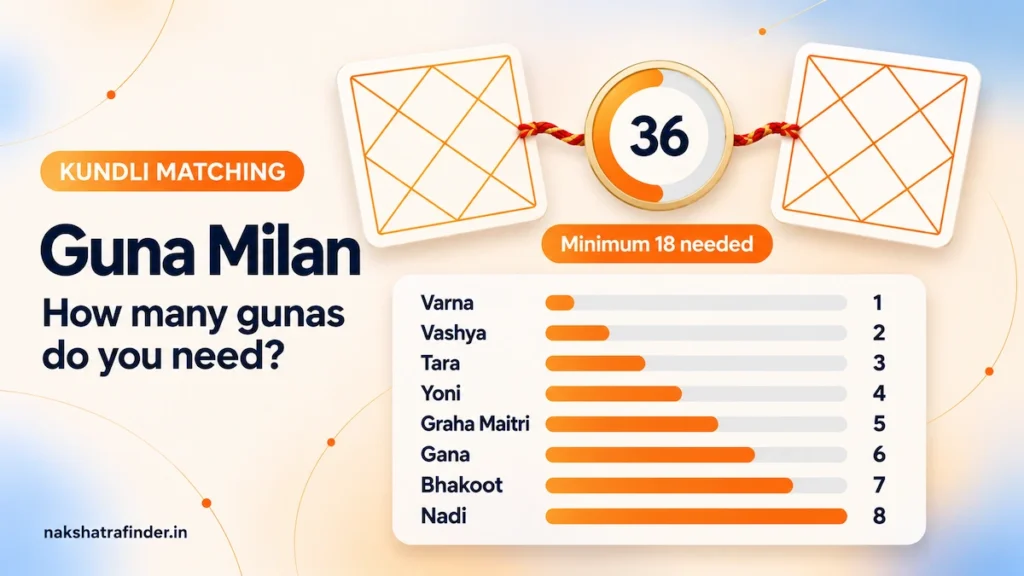
Guna Milan is the scoring system families use to match two horoscopes before marriage. It compares the bride’s and groom’s Moon nakshatras and Moon signs across eight factors, called the Ashtakoot, and gives a total out of 36. Tradition treats 18 as the minimum for a match, but a score on its own leaves a lot out. This guide shows how each of the 36 gunas is calculated, works through a sample pair, and shares what we found when we scored every possible combination of nakshatra padas.
Everything in Guna Milan starts from the Moon. If you are unsure of your Moon nakshatra or its pada, find it first with the Nakshatra calculator, because a birth time that is off by an hour can move the Moon into the next pada and change the score.
- The eight kootas at a glance
- How each koota is scored
- A worked example
- How many gunas are needed for marriage
- What 11,664 pairs tell us
- When Nadi and Bhakoot dosha are cancelled
- What Guna Milan does not check
- Frequently asked questions
The eight kootas of Guna Milan at a glance
Each koota carries a fixed maximum, rising from 1 to 8. Added together they make 36. The heavier kootas, Bhakoot and Nadi, together hold 15 of the 36 points, which is why a single dosha in either one can pull a decent score below the line.
| Koota | Maximum | Compared using | Traditionally said to show |
|---|---|---|---|
| Varna | 1 | Moon sign | Temperament and outlook |
| Vashya | 2 | Moon sign | Mutual attraction and influence |
| Tara | 3 | Nakshatra | Fortune and wellbeing together |
| Yoni | 4 | Nakshatra | Physical and instinctive compatibility |
| Graha Maitri | 5 | Moon sign lords | Friendship and mental wavelength |
| Gana | 6 | Nakshatra | Nature and behaviour |
| Bhakoot | 7 | Moon signs | Family welfare, prosperity and affection |
| Nadi | 8 | Nakshatra | Health and progeny, in traditional belief |
How each koota is scored
Some kootas are symmetric and some are not. Varna, Gana and Tara give different results if you swap the bride and groom, so always enter them the right way round in any calculator.
1. Varna (1 point)
Each Moon sign belongs to one of four varnas, ranked from Brahmin down to Shudra. The water signs (Cancer, Scorpio, Pisces) are Brahmin, the fire signs (Aries, Leo, Sagittarius) Kshatriya, the earth signs (Taurus, Virgo, Capricorn) Vaishya and the air signs (Gemini, Libra, Aquarius) Shudra. The groom’s varna should be equal to or higher than the bride’s for 1 point; otherwise it is 0. Here varna describes the sign’s temperament, not anyone’s caste.
2. Vashya (2 points)
Vashya groups the signs into five kinds of creature and asks whether one partner naturally draws or steadies the other.
| Group | Moon signs |
|---|---|
| Chatushpada (four-footed) | Aries, Taurus, second half of Sagittarius, first half of Capricorn |
| Manava (human) | Gemini, Virgo, Libra, first half of Sagittarius, Aquarius |
| Jalachara (water) | Cancer, Pisces, second half of Capricorn |
| Vanachara (wild) | Leo |
| Keeta (insect) | Scorpio |
Two signs in the same group score 2. Most mixed pairs score 1, and a few score a half or zero; Leo with a human sign is the usual zero. Software makers use slightly different Vashya tables, which is one reason two websites can show the same couple half a point apart.
3. Tara or Dina (3 points)
Count from the bride’s nakshatra to the groom’s, including both, and divide by 9. A remainder of 3, 5 or 7 is unfavourable; these are the Vipat, Pratyari and Naidhana taras. Then count from the groom’s nakshatra to the bride’s and do the same. Both counts favourable gives 3 points, one favourable gives 1.5, and neither gives 0.
4. Yoni (4 points)
Every nakshatra has an animal symbol. The same animal scores 4, friendly animals 3, neutral 2, unfriendly 1 and sworn enemies 0.
| Yoni | Nakshatras | Sworn enemy |
|---|---|---|
| Horse | Ashwini, Shatabhisha | Buffalo |
| Elephant | Bharani, Revati | Lion |
| Sheep | Krittika, Pushya | Monkey |
| Serpent | Rohini, Mrigashira | Mongoose |
| Dog | Ardra, Mula | Deer |
| Cat | Punarvasu, Ashlesha | Rat |
| Rat | Magha, Purva Phalguni | Cat |
| Cow | Uttara Phalguni, Uttara Bhadrapada | Tiger |
| Buffalo | Hasta, Swati | Horse |
| Tiger | Chitra, Vishakha | Cow |
| Deer | Anuradha, Jyeshtha | Dog |
| Monkey | Purva Ashadha, Shravana | Sheep |
| Mongoose | Uttara Ashadha | Serpent |
| Lion | Dhanishtha, Purva Bhadrapada | Elephant |
5. Graha Maitri (5 points)
This koota looks at the lords of the two Moon signs and whether they are natural friends. Mars rules Aries and Scorpio, Venus rules Taurus and Libra, Mercury rules Gemini and Virgo, the Moon rules Cancer, the Sun rules Leo, Jupiter rules Sagittarius and Pisces, and Saturn rules Capricorn and Aquarius.
| Planet | Friends | Neutral | Enemies |
|---|---|---|---|
| Sun | Moon, Mars, Jupiter | Mercury | Venus, Saturn |
| Moon | Sun, Mercury | Mars, Jupiter, Venus, Saturn | None |
| Mars | Sun, Moon, Jupiter | Venus, Saturn | Mercury |
| Mercury | Sun, Venus | Mars, Jupiter, Saturn | Moon |
| Jupiter | Sun, Moon, Mars | Saturn | Mercury, Venus |
| Venus | Mercury, Saturn | Mars, Jupiter | Sun, Moon |
| Saturn | Mercury, Venus | Jupiter | Sun, Moon, Mars |
The same lord, or two lords who are friends of each other, gives 5. Friend and neutral gives 4, both neutral 3, friend and enemy 1, neutral and enemy a half, and mutual enemies 0. Friendship is not always mutual: the Moon treats Mercury as a friend, but Mercury treats the Moon as an enemy, so a Cancer and Gemini pair gets only 1 point here.
6. Gana (6 points)
Gana sorts the nakshatras into three temperaments: Deva (gentle), Manushya (human, mixed) and Rakshasa (fierce, independent).
| Gana | Nakshatras |
|---|---|
| Deva | Ashwini, Mrigashira, Punarvasu, Pushya, Hasta, Swati, Anuradha, Shravana, Revati |
| Manushya | Bharani, Rohini, Ardra, Purva Phalguni, Uttara Phalguni, Purva Ashadha, Uttara Ashadha, Purva Bhadrapada, Uttara Bhadrapada |
| Rakshasa | Krittika, Ashlesha, Magha, Chitra, Vishakha, Jyeshtha, Mula, Dhanishtha, Shatabhisha |
| Groom \ Bride | Deva | Manushya | Rakshasa |
|---|---|---|---|
| Deva | 6 | 6 | 1 |
| Manushya | 5 | 6 | 0 |
| Rakshasa | 1 | 0 | 6 |
7. Bhakoot (7 points)
Count the distance between the two Moon signs in both directions. If the pair sits 1/1 (same sign), 3/11, 4/10 or 7/7 apart, Bhakoot gets the full 7. If it sits 2/12, 5/9 or 6/8 apart, it gets 0, and that is Bhakoot dosha. A Taurus girl and a Virgo boy, for example, are 5/9 apart, because Virgo is the 5th sign from Taurus and Taurus the 9th from Virgo.
8. Nadi (8 points)
The 27 nakshatras run in a zigzag through three nadis. If both partners share a nadi, the score is 0 and the pair has Nadi dosha. Different nadis give the full 8.
| Nadi | Nakshatras |
|---|---|
| Adi (Vata) | Ashwini, Ardra, Punarvasu, Uttara Phalguni, Hasta, Jyeshtha, Mula, Shatabhisha, Purva Bhadrapada |
| Madhya (Pitta) | Bharani, Mrigashira, Pushya, Purva Phalguni, Chitra, Anuradha, Purva Ashadha, Dhanishtha, Uttara Bhadrapada |
| Antya (Kapha) | Krittika, Rohini, Ashlesha, Magha, Swati, Vishakha, Uttara Ashadha, Shravana, Revati |
A worked Guna Milan example
Take a groom born with the Moon in Hasta nakshatra, pada 3, so his Moon sign is Virgo, and a bride with the Moon in Rohini nakshatra, pada 2, so her Moon sign is Taurus.
| Koota | Points | Why |
|---|---|---|
| Varna | 1 of 1 | Virgo and Taurus are both Vaishya |
| Vashya | 1 of 2 | Virgo is human, Taurus four-footed |
| Tara | 3 of 3 | Counts of 10 and 19 both leave a remainder of 1 |
| Yoni | 1 of 4 | Buffalo and Serpent are rated unfriendly |
| Graha Maitri | 5 of 5 | Mercury and Venus are mutual friends |
| Gana | 6 of 6 | Deva groom with a Manushya bride |
| Bhakoot | 0 of 7 | Taurus and Virgo are 5/9 apart |
| Nadi | 8 of 8 | Hasta is Adi, Rohini is Antya |
| Total | 25 of 36 |
Twenty-five is a good score, yet the pair carries Bhakoot dosha. The commonly cited exception sets the dosha aside here, because the two sign lords, Mercury and Venus, are friends of each other. That matters more than the headline number, and a calculator that only prints “25/36” would not tell you about it.
How many gunas are required for marriage?
The traditional minimum is 18 of 36, half the total. The bands below are a common way to read a score, provided Nadi and Bhakoot are checked separately.
| Score | Usual reading |
|---|---|
| Below 18 | Not recommended without a full chart review |
| 18 to 24 | Acceptable, if there is no uncancelled Nadi or Bhakoot dosha |
| 25 to 32 | Good match |
| 33 to 36 | Excellent, and rare |
A score of 26 with an uncancelled Nadi dosha is usually treated with more caution than a score of 20 with no dosha at all. Read the koota breakdown, not just the total.
What 11,664 nakshatra pairs tell us about Guna Milan
There are 108 nakshatra padas, so there are 108 × 108 = 11,664 possible groom and bride combinations. The Moon spends about the same time in each pada, so scoring all of them shows what a typical couple can expect. We ran every pair through the rules above.
| Finding | Share of all pairs |
|---|---|
| Average score | 20.9 of 36 |
| Score of 18 or more | 69.7% |
| Score of 24 or more | 37.0% |
| Score of 28 or more | 11.9% |
| Score of 32 or more | 1.7% |
| Full 36 of 36 | 0.07% (8 pairs) |
| Nadi dosha | 33.3% |
| Bhakoot dosha | 50.0% |
| Gana score of 0 | 22.2% |
| Both Nadi and Bhakoot dosha | 14.6% |
Seven in ten random pairs cross 18, so the minimum is easy to clear. Bhakoot dosha is everywhere: six of the twelve possible sign relationships count as dosha, so half of all couples have it before any exception is applied. And of the pairs that score 18 or more, 55% still carry Nadi or Bhakoot dosha, so passing 18 does not mean a clean result.
A perfect 36 is possible in only one combination: a groom with the Moon in Mrigashira pada 1 or 2 (Taurus) and a bride with the Moon in Rohini. They share the Serpent yoni and the sign Taurus, sit in different nadis, and the Deva groom with a Manushya bride scores the full Gana points. Swap the two and the score drops to 35.
When Nadi and Bhakoot dosha are cancelled
Classical muhurta texts list exceptions, called parihara, that soften these two doshas. Different schools accept different lists, so treat these as the commonly cited ones rather than a fixed law.
Nadi dosha is usually considered cancelled when:
- both partners share a Moon sign but have different nakshatras;
- they share a nakshatra but the Moon falls in different signs, which can happen with nakshatras that cross a sign boundary, such as Krittika or Chitra;
- they share a nakshatra and sign but are in different padas, which some astrologers accept and others do not.
Bhakoot dosha is most often set aside when the two Moon signs have the same lord, as with Aries and Scorpio (both Mars), or when the two lords are mutual friends, as in the Hasta and Rohini example.
Our pair analysis shows how differently these work in practice. Only 12% of Nadi dosha pairs meet one of the three Nadi exceptions above. For Bhakoot, 47% of dosha pairs have the same or mutually friendly sign lords. So a Bhakoot dosha is often softened; a Nadi dosha usually is not.
What Guna Milan does not check
Guna Milan uses only the position of the Moon. It says nothing about the rest of the chart, so a full matching reading also looks at:
- Mangal dosha, from Mars in the 1st, 2nd, 4th, 7th, 8th or 12th house. You can check it with the Mangal dosha calculator, and our Mangal dosha guide explains how it is cancelled.
- The 7th house and its lord in both charts, and Venus for both partners.
- The Navamsa (D9) chart, which classical astrology treats as the chart of marriage.
- The dashas both people will run in the first years of marriage.
South India uses a different system, the ten poruthams (Dashakoota), which overlaps with Ashtakoot but adds checks such as Rajju and Vedha. If your families follow that tradition, a North Indian 36-point score is only part of the picture.
How to check your own Guna Milan score
Enter both birth dates, times and places in the free Kundli matching tool. It shows all eight kootas with their points, not just the total. Check the birth times carefully, since the Moon moves about one pada every six hours. If the score is borderline or a dosha shows up, look at the full birth chart with a free Kundli, or get a detailed reading from our premium Kundli reports before the families decide.
Frequently asked questions
How many gunas should match for a good marriage?
Tradition asks for at least 18 of 36. Scores from 25 upward are considered good, provided there is no uncancelled Nadi or Bhakoot dosha.
Is a 36 guna match possible?
Yes, but it is very rare. With the standard tables, only a Mrigashira groom (pada 1 or 2) and a Rohini bride reach 36. That is 8 of 11,664 pada combinations.
What happens if fewer than 18 gunas match?
Tradition does not approve a match on a low score alone, and the full charts are checked next. Strong 7th houses, a supportive Navamsa and good dashas are often weighed against a low score.
Which guna is most important in Kundli matching?
Nadi carries the most points (8), followed by Bhakoot (7) and Gana (6). A zero in Nadi or Bhakoot is treated as a dosha and gets more attention than a low score in any other koota.
Does Guna Milan matter for a love marriage?
Many families still check it. Practice varies: some give the score less weight when the couple already know each other well, and focus on doshas and the 7th house instead.
How this guide was prepared: the koota rules follow the Ashtakoot system as used in North Indian matching software. The pair statistics come from Nakshatra Finder scoring all 11,664 nakshatra pada combinations with those rules. Vashya and Yoni tables vary slightly between sources, so individual scores may differ by up to a point from other calculators.
About this guide
- Written by
- Vishal Sharma
- Last reviewed
Astrologer, numerologist and Reiki practitioner who also practises tantra. He writes and reviews the Nakshatra, Kundli and Panchang guides on Nakshatra Finder.
Nakshatra Finder guides draw on classical Jyotish sources and Vedic texts, and the positions, padas and spans quoted here follow the sidereal zodiac with the Lahiri (Chitrapaksha) ayanamsha, the same standard our Nakshatra calculator uses. Traits describe tendencies, not certainties: a full reading needs your whole chart.
Spotted an error? Email contact@nakshatrafinder.in and we will review it. Read more about Nakshatra Finder and our disclaimer.
Astrology is a traditional system of guidance. It is not a substitute for medical, legal or financial advice.
5 thoughts on “Guna Milan: How Many Gunas Do You Really Need? Easy 36-Guna Guide With Full Ashtakoot Tables”