How to Find Your Nakshatra: 4 Easy Ways, a Worked Example and the Full Nakshatra Table
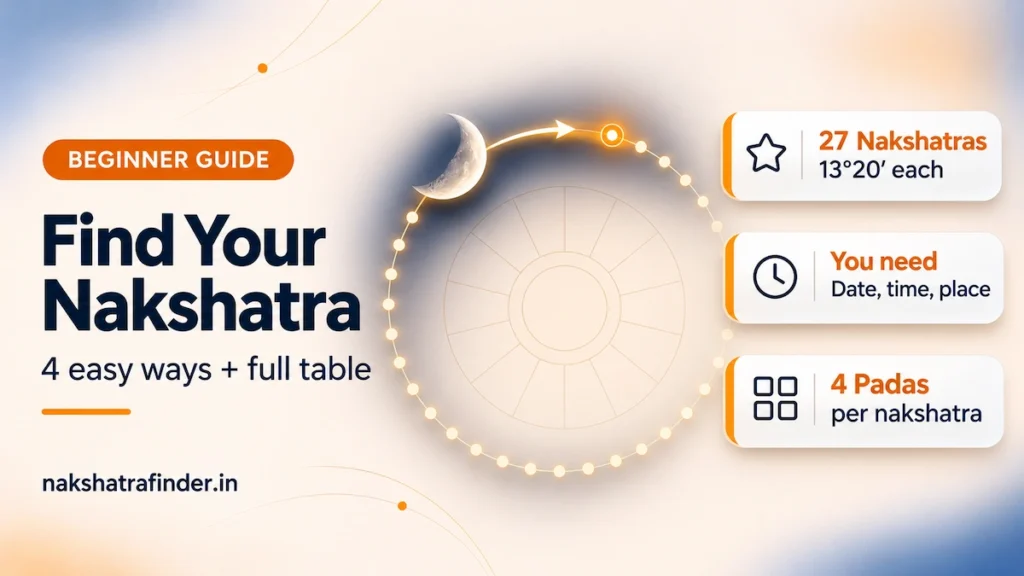
Your nakshatra, also called your Janma Nakshatra or birth star, is the one of 27 lunar mansions that the Moon was passing through at the moment you were born. To find it you need three things: your date of birth, your time of birth and your place of birth. The quickest way is to enter them in a Nakshatra calculator, which gives your nakshatra, its pada (quarter), your Moon sign and the nakshatra lord in a few seconds.
This guide shows you how to find your nakshatra in four ways, walks through a manual calculation step by step, gives the full table of nakshatra degrees and lords, and explains why knowing only the date of birth is usually not enough.
Table of Contents
What your birth nakshatra is
The Moon circles the zodiac in about 27.3 days. Vedic astrology divides its path into 27 equal sections of 13°20′ each, one for roughly every day of the Moon’s journey. Each section is a nakshatra, named after the star or group of stars it contains, ruled by a planet and associated with a deity. Each nakshatra is further split into four padas of 3°20′, and the 27 × 4 = 108 padas map exactly onto the 12 signs, nine padas to a sign.
Your birth nakshatra is used for far more than personality reading. It sets the starting point of your Vimshottari dasha, decides the first syllable of your traditional name, is the basis of Guna Milan in marriage matching, and is the reference for Tara bala when choosing a muhurat. In South India it is also the “star” used for temple archanas and birthdays.
How to find your nakshatra: four easy ways
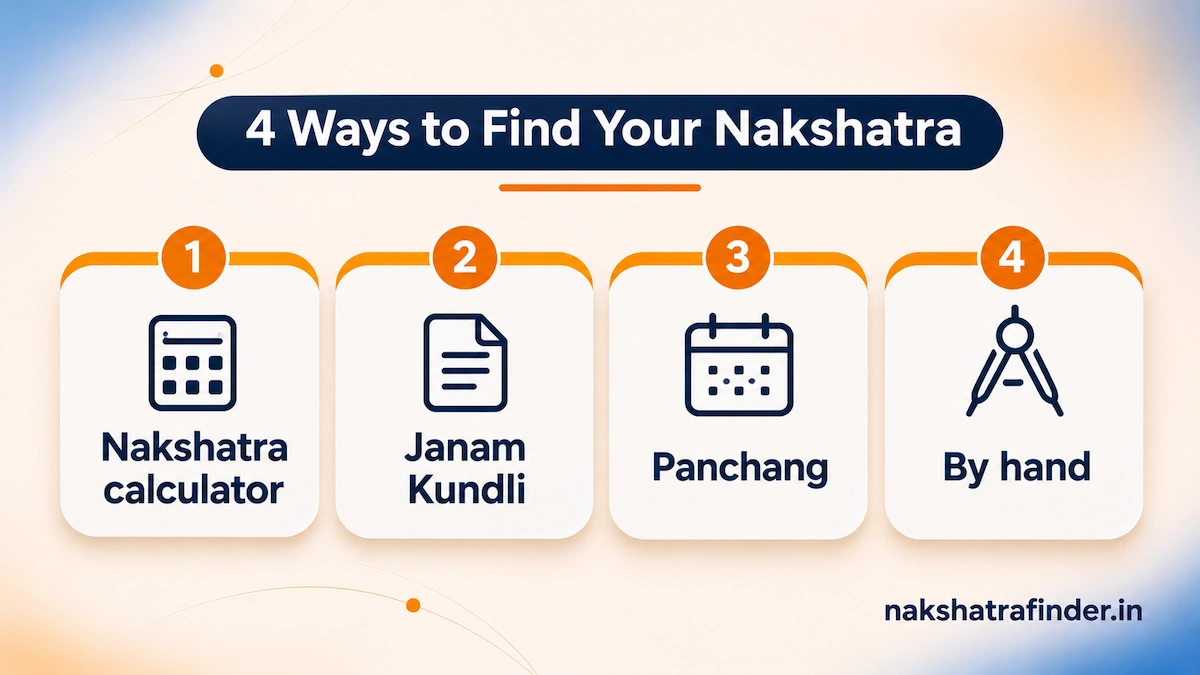
1. Use a Nakshatra calculator
Enter your date, time and place of birth in the Nakshatra Finder calculator. It computes the Moon’s sidereal position for that exact moment and returns your nakshatra, pada, Moon sign (rashi) and nakshatra lord. This is the most reliable method because it uses an astronomical ephemeris and handles time zones and historical clock changes for you.
2. Check your Janam Kundli
If your family had a horoscope made when you were born, the nakshatra is usually written near the top, labelled Janma Nakshatra, Nakshatra or Star, often with the charan (pada) and the rashi. You can also generate a free Kundli online; the nakshatra appears in the birth details along with the chart.
3. Look up the Panchang for your birth date
Every Panchang lists the nakshatra for each day along with the time it ends. If your birth time is before that end time, your nakshatra is the one listed; if it is after, it is the next one. Old printed Panchangs work too, but be careful with the place: the end time printed for one city can differ from yours, and some older almanacs use local mean time rather than IST.
4. Calculate it by hand
If you have the Moon’s position from any ephemeris or astronomy app, you can work out the nakshatra yourself in four steps, as shown below.
How to calculate your nakshatra by hand: a worked example
Take a person born on 15 August 1995 at 10:30 AM in New Delhi.
- Find the Moon’s tropical longitude. Most Western ephemerides and astronomy apps give the tropical position. At this moment the Moon is at about 18°44′ Aries, which is 18.73° counted from 0° Aries.
- Subtract the ayanamsha. Vedic astrology uses the sidereal zodiac, which is offset from the tropical one by the ayanamsha. The standard Lahiri value in August 1995 was about 23°48′ (23.80°). 18.73° minus 23.80° is negative, so add 360°: the sidereal Moon is at 354.93°.
- Find the sign. 354.93° ÷ 30 = 11.83, so the Moon is in the 12th sign, Pisces, at 24°56′.
- Find the nakshatra and pada. Divide by 13.333 (13°20′): 354.93 ÷ 13.333 = 26.62, so 26 full nakshatras have passed and the Moon is in the 27th, Revati. It is 8.26° into Revati, and 8.26 ÷ 3.333 = 2.48, so it is in the 3rd pada.
Result: Revati nakshatra, pada 3, Moon sign Pisces. Notice that a Western astrologer would call this person’s Moon sign Aries. The ayanamsha, now just over 24°, shifts the Moon into a different sign in about four out of five charts, which is why Vedic and Western Moon signs so often disagree.
Table of all 27 nakshatras with degrees and lords
Use this table to turn any sidereal Moon position into a nakshatra. Each name links to our full guide to that nakshatra’s traits, padas, career and marriage.
| Nakshatra | Sidereal range | Lord |
|---|---|---|
| 1. Ashwini | Aries 0° to 13°20′ | Ketu |
| 2. Bharani | Aries 13°20′ to 26°40′ | Venus |
| 3. Krittika | Aries 26°40′ to Taurus 10° | Sun |
| 4. Rohini | Taurus 10° to 23°20′ | Moon |
| 5. Mrigashira | Taurus 23°20′ to Gemini 6°40′ | Mars |
| 6. Ardra | Gemini 6°40′ to 20° | Rahu |
| 7. Punarvasu | Gemini 20° to Cancer 3°20′ | Jupiter |
| 8. Pushya | Cancer 3°20′ to 16°40′ | Saturn |
| 9. Ashlesha | Cancer 16°40′ to 30° | Mercury |
| 10. Magha | Leo 0° to 13°20′ | Ketu |
| 11. Purva Phalguni | Leo 13°20′ to 26°40′ | Venus |
| 12. Uttara Phalguni | Leo 26°40′ to Virgo 10° | Sun |
| 13. Hasta | Virgo 10° to 23°20′ | Moon |
| 14. Chitra | Virgo 23°20′ to Libra 6°40′ | Mars |
| 15. Swati | Libra 6°40′ to 20° | Rahu |
| 16. Vishakha | Libra 20° to Scorpio 3°20′ | Jupiter |
| 17. Anuradha | Scorpio 3°20′ to 16°40′ | Saturn |
| 18. Jyeshtha | Scorpio 16°40′ to 30° | Mercury |
| 19. Mula | Sagittarius 0° to 13°20′ | Ketu |
| 20. Purva Ashadha | Sagittarius 13°20′ to 26°40′ | Venus |
| 21. Uttara Ashadha | Sagittarius 26°40′ to Capricorn 10° | Sun |
| 22. Shravana | Capricorn 10° to 23°20′ | Moon |
| 23. Dhanishtha | Capricorn 23°20′ to Aquarius 6°40′ | Mars |
| 24. Shatabhisha | Aquarius 6°40′ to 20° | Rahu |
| 25. Purva Bhadrapada | Aquarius 20° to Pisces 3°20′ | Jupiter |
| 26. Uttara Bhadrapada | Pisces 3°20′ to 16°40′ | Saturn |
| 27. Revati | Pisces 16°40′ to 30° | Mercury |
The nine lords repeat three times in the same order: Ketu, Venus, Sun, Moon, Mars, Rahu, Jupiter, Saturn, Mercury. This is the same sequence as the Vimshottari dasha, which is why your birth nakshatra’s lord is also the lord of the first Mahadasha of your life.
Why birth time matters
People often ask whether they can find their nakshatra from the date of birth alone. In most cases the answer is no, not with certainty. We checked every day from 1990 to 2019 and calculated how many nakshatras the Moon touched in each 24 hours in India:
| Situation | Share of days |
|---|---|
| One nakshatra for the whole day | 4.2% |
| Two nakshatras in the day | 92.9% |
| Three nakshatras in the day | 2.9% |
So on more than 95% of days there are at least two possible nakshatras, and the birth time decides which. The Moon’s speed varies, so a nakshatra lasts anywhere from about 20.7 to 27.2 hours, with an average of a little over 24 hours.
Precision matters at the pada level too. In a sample of 50,000 random birth moments, shifting the time by just one hour changed the nakshatra in 4.1% of cases and the pada in 16.4% of cases. The pada decides your name syllable and your Navamsa, so a birth time rounded to the nearest hour can give you the wrong letter.
If you do not know your birth time
- Ask for the hospital discharge papers or the birth certificate; many record the time.
- Check with older relatives whether a horoscope was made at the time.
- If you know a rough window, such as “early morning”, enter the start and the end of it in the calculator. If both give the same nakshatra, you have your answer.
- If the two ends differ, an astrologer can sometimes narrow it down through birth time rectification, using known life events.
What to do once you know your nakshatra
- Read about it: open your nakshatra from the table above to see its traits, the meaning of your pada, and its strengths in career and marriage.
- Choose a name: the baby name by nakshatra tool lists names that start with the syllable of each pada.
- Check compatibility: Guna Milan is built on the two partners’ nakshatras; see our guide to Guna Milan and the 36 gunas or use the Kundli matching tool.
- Know your dasha: your nakshatra lord starts your Vimshottari dasha sequence. For a personal reading of your nakshatra and pada, see the ₹99 Nakshatra Report.
Frequently asked questions
Can I find my nakshatra by date of birth only?
Only on about 4% of days, when the Moon stays in one nakshatra for the whole day. On the other days you will get two or three candidates, and the birth time decides between them. This is the main reason the “how to find your nakshatra” question needs a birth time, not just a date.
Is the nakshatra based on the Moon or the Sun?
Your birth nakshatra is the nakshatra of the Moon. Every planet occupies some nakshatra, and astrologers look at the Sun’s and the ascendant’s too, but “my nakshatra” always means the Moon’s.
What is the difference between nakshatra and rashi?
Both describe the Moon’s position. The rashi is the sign, one of 12 sections of 30°, and the nakshatra is one of 27 sections of 13°20′. The nakshatra is the finer of the two, and each rashi contains two and a quarter nakshatras.
Why does my nakshatra differ between two websites?
Usually because of a different birth time, a wrong place or time zone, or a different ayanamsha. Most Indian astrologers use Lahiri; a few websites default to other values or to the tropical zodiac, which gives a completely different result.
What is a pada?
A quarter of a nakshatra, 3°20′ wide. Each pada has its own name syllable and falls in a particular Navamsa sign, so it adds detail to the nakshatra reading.
How this guide was prepared: the worked example, the day-by-day nakshatra counts for 1990 to 2019 and the birth time sensitivity figures were calculated by Nakshatra Finder with the Swiss Ephemeris and the Lahiri (Chitrapaksha) ayanamsha. The method is shared for learning; for a reading of what your nakshatra means, a qualified astrologer can help.
About this guide
- Written by
- Vishal Sharma
- Last reviewed
Astrologer, numerologist and Reiki practitioner who also practises tantra. He writes and reviews the Nakshatra, Kundli and Panchang guides on Nakshatra Finder.
Nakshatra Finder guides draw on classical Jyotish sources and Vedic texts, and the positions, padas and spans quoted here follow the sidereal zodiac with the Lahiri (Chitrapaksha) ayanamsha, the same standard our Nakshatra calculator uses. Traits describe tendencies, not certainties: a full reading needs your whole chart.
Spotted an error? Email contact@nakshatrafinder.in and we will review it. Read more about Nakshatra Finder and our disclaimer.
Astrology is a traditional system of guidance. It is not a substitute for medical, legal or financial advice.



1 thought on “How to Find Your Nakshatra: 4 Easy Ways, a Worked Example and the Full Nakshatra Table”