Uttara Ashadha Nakshatra: Traits, Padas, Career, Marriage and Remedies
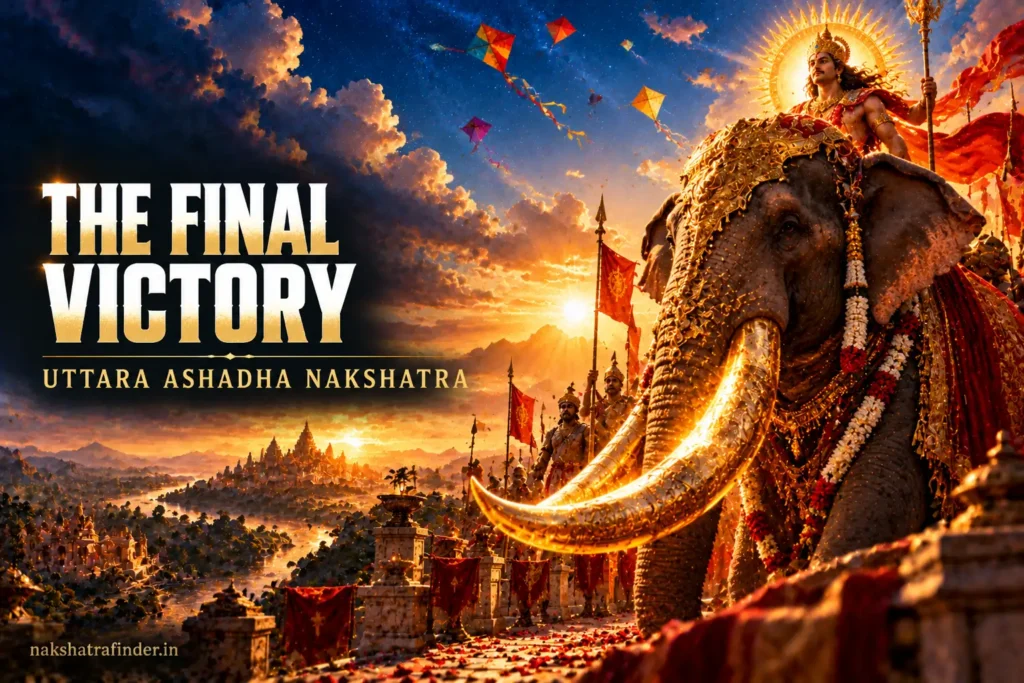
Uttara Ashadha Nakshatra means “the later invincible one”. It is the twenty-first Nakshatra and crosses from Sagittarius into Capricorn, and the Sun passes through it in mid January, right when India celebrates Makar Sankranti, Pongal and the start of Uttarayana. Its deities are the Vishvedevas, the “universal gods”, and its ruling planet is the Sun. Uttara Ashadha natives are known for integrity, staying power and victories that come late but last.
This guide covers the Vishvedevas, the symbols of the Nakshatra, men and women born under it, the four padas, careers, compatibility, muhurta and its place in the festival calendar. Treat these as tendencies; your whole chart gives the full picture.
Not sure which Nakshatra you were born under? Find your Nakshatra by date of birth with our free calculator. It also shows your pada, rashi and the traditional first letter for a name.
Uttara Ashadha Nakshatra at a glance
| Attribute | Uttara Ashadha |
|---|---|
| Position | 21st of 27 Nakshatras |
| Span (sidereal) | Sagittarius 26°40′ to Capricorn 10°00′ |
| Rashi | Pada 1 in Sagittarius (Dhanu), padas 2 to 4 in Capricorn (Makara) |
| Ruling planet | Sun |
| Deity | The Vishvedevas, the universal gods |
| Symbol | An elephant tusk; also the planks of a bed |
| Gana | Manushya (human) |
| Nadi | Antya (Kapha) |
| Yoni | Mongoose (male) |
| Muhurta nature | Dhruva (fixed, steady) |
| Name syllables | Be, Bo, Ja, Ji |
| Principal stars | Nunki and Ascella (Sigma and Zeta Sagittarii) |
| Sun’s yearly transit | About 10 to 23 January |
The Vishvedevas: all the gods together
The Vishvedevas are not a single god but the gods as a collective: the “all-gods”, invoked together so that no deity is left out of a ritual. Later texts list ten of them, with names such as Vasu (goodness), Satya (truth), Kratu (will), Daksha (skill), Kala (time), Kama (desire), Dhriti (steadfastness), Kuru, Pururavas and Madravas. They are honoured in ancestral rites and in many household offerings.
Because the Vishvedevas represent universal principles such as truth, steadfastness and right effort, Uttara Ashadha is closely linked with integrity. Natives tend to want to win the right way, and a victory gained unfairly gives them little satisfaction. They often think in terms of what is good for everyone, not only for themselves, which makes them respected leaders and reliable colleagues.
What the elephant tusk and the bed planks mean
The elephant tusk, shared with Purva Ashadha, stands for strength, dignity and a power that few challenge. In Uttara Ashadha it is also linked with Ganesha, whose broken tusk was used, in one story, to write down the Mahabharata. That gives the symbol a sense of strength put to the service of something lasting.
The planks of a bed, like the back legs of the cot in Uttara Phalguni, point to support and stability. The “Uttara” Nakshatras (Uttara Phalguni, Uttara Ashadha and Uttara Bhadrapada) are all fixed in muhurta and all associated with completing what the “Purva” Nakshatras began. Uttara Ashadha consolidates the energy of Purva Ashadha into something steady.
Personality
Strengths
- Integrity. Uttara Ashadha natives care about fairness and doing the right thing.
- Persistence. They work steadily towards long-term goals and rarely quit.
- Leadership. The Sun and Capricorn give authority and the ability to organise.
- Responsibility. They take duties seriously, often from a young age.
- Lasting success. Achievements may come later in life but tend to endure.
Challenges
- Rigidity. Strong principles can become inflexibility.
- Seriousness. They may find it hard to relax or play.
- Self-righteousness. A strong moral sense can slide into judging others.
- Delayed rewards. Patience is needed, since results often arrive slowly.
Uttara Ashadha Nakshatra men and women
Uttara Ashadha Nakshatra men are traditionally described as principled, hardworking and respected, often rising to positions of authority through steady effort. They tend to be loyal to family and friends, though their reserve can make them seem distant.
Uttara Ashadha women are described as dignified, capable and ethical, often successful in careers and respected for their judgment. They usually take family responsibilities seriously and can be the stable centre of a household. Both men and women of this Nakshatra tend to grow more confident and content in the second half of life.
The Sun’s role and your first Mahadasha
Uttara Ashadha Nakshatra is ruled by the Sun, so natives begin life in the Sun Mahadasha, which lasts six years in full. The Moon’s ten years follow, then Mars’s seven, Rahu’s eighteen and Jupiter’s sixteen. The Sun’s influence often shows in early respect for authority, a strong relationship with the father and a sense of duty.
Since most of the Nakshatra falls in Capricorn, Saturn’s sign, many natives combine the Sun’s need for recognition with Saturn’s discipline. That mix explains the reputation for slow, solid success. Check your Sun’s strength and Dasha balance in our free Kundli.
Uttara Ashadha Nakshatra padas
Pada 1: Sagittarius 26°40′ to 30°00′ (Sagittarius Navamsa, ruled by Jupiter)
A Vargottama pada, with Sagittarius in both the sign and the Navamsa. Jupiter’s influence is strong, making these natives idealistic, philosophical and generous. They suit teaching, law, religion and public service. Name syllable: Be.
Pada 2: Capricorn 0°00′ to 3°20′ (Capricorn Navamsa, ruled by Saturn)
Another Vargottama pada, now for Capricorn. Saturn’s discipline and ambition are at their strongest here. These natives are practical, hardworking and focused on status and security, suited to business, administration and engineering. Name syllable: Bo.
Pada 3: Capricorn 3°20′ to 6°40′ (Aquarius Navamsa, ruled by Saturn)
The Aquarius Navamsa adds a humanitarian, forward-looking side. Natives may be drawn to science, technology, social reform and group leadership. Name syllable: Ja.
Pada 4: Capricorn 6°40′ to 10°00′ (Pisces Navamsa, ruled by Jupiter)
Pisces softens the pada with compassion and imagination. These natives may be drawn to spiritual work, healing, the arts or charity, combining Capricorn’s discipline with genuine kindness. Name syllable: Ji.
Browse names that begin with Be, Bo, Ja and Ji in our baby names by Nakshatra.
Career
- Government service, administration and public leadership
- Law, the judiciary and ethics-related roles
- Business management and long-term projects
- Engineering, architecture and construction
- Teaching, religious work and social causes
- Defence and organisations with clear hierarchies
Uttara Ashadha natives usually do best in careers where reputation is built over time. They tend to be trusted with responsibility because they are known to be fair and reliable.
Love, marriage and compatibility
Uttara Ashadha Nakshatra natives are serious about commitment. They show love through loyalty and responsibility more than romance, and they look for a partner who shares their values. They may need encouragement to express emotions openly.
- Yoni (4 points): Uttara Ashadha is the only Nakshatra with the mongoose yoni, so no other Nakshatra shares it exactly. The serpent is the mongoose’s traditional enemy, so matches with Rohini and Mrigashira lose points here.
- Gana (6 points): as a Manushya Nakshatra, it matches easily with Bharani, Rohini, Ardra, the Phalgunis, Purva Ashadha and the two Bhadrapadas.
- Nadi (8 points): Uttara Ashadha is Antya Nadi. A partner from another Antya Nadi Nakshatra (Krittika, Rohini, Ashlesha, Magha, Swati, Vishakha, Shravana or Revati) creates Nadi Dosha.
Uttara Ashadha is also one of the Nakshatras traditionally favoured for the wedding ceremony itself. See any couple’s full score with the Kundli matching tool.
Health and wellbeing
Capricorn is traditionally linked with the knees, bones and joints, and the Kapha nadi with a tendency towards sluggishness when routines lapse. Regular exercise and a balanced pace of work help a Nakshatra that tends to work hard and rest little. Consult a qualified doctor for any health concern.
Using Uttara Ashadha Nakshatra for muhurta
Uttara Ashadha Nakshatra belongs to the Dhruva (fixed) group with Rohini, Uttara Phalguni and Uttara Bhadrapada. Fixed Nakshatras are chosen for lasting beginnings:
- Weddings and engagements
- Laying foundations and entering a new home
- Coronations, oaths of office and taking on major responsibilities
- Long-term investments and planting
Check the full Panchang for your city on our daily Panchang before fixing a date.
Remedies and supportive practices
- Honour the Sun. Surya arghya at sunrise and the Aditya Hridayam are the classic Sun practices. The beej mantra is Om Hraam Hreem Hraum Sah Suryaya Namah.
- Worship Ganesha. Through the tusk symbol, Ganesha worship is widely recommended for this Nakshatra, especially before new undertakings.
- Act with integrity. Keeping promises and fair dealing are the most direct ways to honour the Vishvedevas.
- Gemstones only after a chart check. Ruby is the Sun’s stone; ask a qualified astrologer first.
Uttara Ashadha and Makar Sankranti
The Sun enters sidereal Capricorn around 14 January, while passing through Uttara Ashadha. That moment is Makar Sankranti, celebrated as Pongal in Tamil Nadu, Uttarayan in Gujarat, Lohri the evening before in Punjab and Magh Bihu in Assam. It marks the start of the auspicious half of the year in traditional reckoning. Between the last pada of Uttara Ashadha and the start of Shravana lies Abhijit, the “28th Nakshatra” used in some muhurta systems and considered highly auspicious.
When the Moon transits Uttara Ashadha Nakshatra
Uttara Ashadha is a fixed Nakshatra, so the day each month when the Moon is here is traditionally preferred for lasting commitments: weddings, foundation stones, griha pravesh, taking an oath of office or starting a long-term investment. Sundays that fall on Uttara Ashadha are considered strong for Sun remedies.
It is a good day to make decisions you intend to keep and to act with integrity in difficult matters. Many people also begin Ganesha worship on these days before a new undertaking.
For your own birth star, the day the Moon returns to it is your Janma Tara. In Tara Bala, the system that compares the day’s Nakshatra with your birth Nakshatra, the Janma Tara is traditionally avoided for major new beginnings such as signing a large contract, although in South India the same day in your birth month is celebrated as your star birthday. You can check the day’s Nakshatra on our daily Panchang.
Frequently asked questions
Which rashi is Uttara Ashadha Nakshatra in?
Pada 1 is in Sagittarius (Dhanu). Padas 2, 3 and 4 are in Capricorn (Makara).
What are the name letters for Uttara Ashadha Nakshatra?
Be, Bo, Ja and Ji for padas 1 to 4.
Why does Uttara Ashadha have no matching Yoni?
It is the only Nakshatra assigned the mongoose, so no other Nakshatra scores the maximum with it on Yoni. Friendly animals still score well; the serpent Nakshatras score lowest.
Is Uttara Ashadha good for marriage?
Yes, it is a fixed Nakshatra traditionally favoured for weddings. Compatibility with a particular partner still needs a full Kundli match.
What is Uttara Ashadha’s first Mahadasha?
The Sun Mahadasha, with up to six years remaining at birth.
Uttara Ashadha follows Purva Ashadha and leads into Shravana, the Nakshatra of listening. Find your own birth star with the Nakshatra calculator.
About this guide
- Written by
- Vishal Sharma
- Last reviewed
Astrologer, numerologist and Reiki practitioner who also practises tantra. He writes and reviews the Nakshatra, Kundli and Panchang guides on Nakshatra Finder.
Nakshatra Finder guides draw on classical Jyotish sources and Vedic texts, and the positions, padas and spans quoted here follow the sidereal zodiac with the Lahiri (Chitrapaksha) ayanamsha, the same standard our Nakshatra calculator uses. Traits describe tendencies, not certainties: a full reading needs your whole chart.
Spotted an error? Email contact@nakshatrafinder.in and we will review it. Read more about Nakshatra Finder and our disclaimer.
Astrology is a traditional system of guidance. It is not a substitute for medical, legal or financial advice.