Dhanishtha Nakshatra: Traits, Padas, Career, Marriage and Remedies
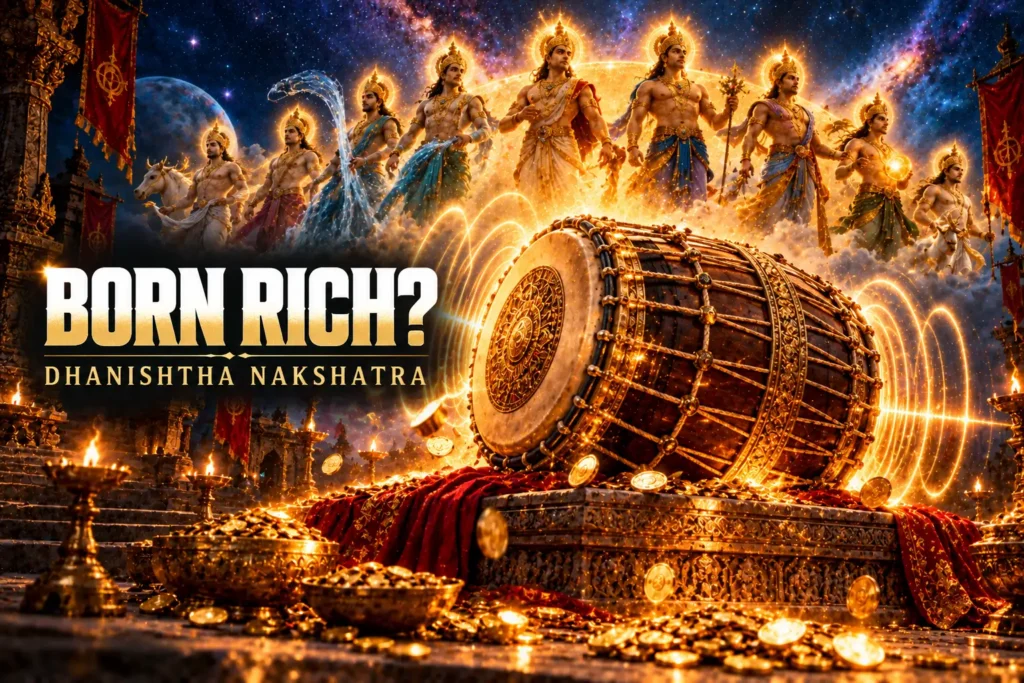
Dhanishtha Nakshatra means “the wealthiest” or “the most famous”. It is the twenty-third Nakshatra and crosses from Capricorn into Aquarius, marked in the sky by the small diamond of stars in the constellation Delphinus. Its deities are the Ashta Vasus, the eight gods of abundance and the elements, and its ruling planet is Mars. In the south it is also called Avittam. Dhanishtha natives are often energetic, sociable and musical, with a good sense of timing in work and in life.
Dhanishtha is also where Panchak begins, a five-Nakshatra period that traditional muhurta treats with caution for certain activities. This guide covers the Vasus, the drum symbol, men and women of this Nakshatra, its four padas, careers, compatibility, Panchak and remedies. These are tendencies that the full chart can strengthen or change.
Not sure which Nakshatra you were born under? Find your Nakshatra by date of birth with our free calculator. It also shows your pada, rashi and the traditional first letter for a name.
Dhanishtha Nakshatra at a glance
| Attribute | Dhanishtha |
|---|---|
| Position | 23rd of 27 Nakshatras |
| Span (sidereal) | Capricorn 23°20′ to Aquarius 6°40′ |
| Rashi | Padas 1 and 2 in Capricorn (Makara), padas 3 and 4 in Aquarius (Kumbha) |
| Ruling planet | Mars |
| Deity | The Ashta Vasus, eight gods of abundance and the elements |
| Symbol | A drum (mridanga); also a flute |
| Gana | Rakshasa (fierce) |
| Nadi | Madhya (Pitta) |
| Yoni | Lion (female) |
| Muhurta nature | Chara (movable) |
| Name syllables | Ga, Gi, Gu, Ge |
| Principal stars | The four main stars of Delphinus |
| Sun’s yearly transit | About 6 to 18 February |
The Ashta Vasus: the gods of abundance
The Vasus are a group of eight gods attached to Indra, usually linked with the elements and the visible world: earth, water, fire, wind, sky, the Sun, the Moon and the stars, though the names vary by text. Their name comes from a root meaning “to dwell” or “to shine”, and they are associated with wealth, light and the good things of the world.
The Mahabharata tells how the eight Vasus were cursed by the sage Vashishtha to be born as humans after one of them stole his wish-fulfilling cow. They were born as sons of the river goddess Ganga, who released seven of them at birth by returning them to her waters. The eighth, who had stolen the cow, lived a full human life as Bhishma, the great elder of the epic, known for his vows and his loyalty. Dhanishtha shares something of this story: abundance and talent, combined with duty that sometimes comes at a personal cost.
What the drum means
A drum is hollow, and that emptiness is what lets it resonate. The symbol suggests that Dhanishtha’s gifts come through rhythm, timing and the ability to respond to what is around it. Natives are often musical, enjoy dance and performance, and have a strong sense of when to act. In work, that shows up as good timing, the ability to catch a wave and to keep a team moving to the same beat.
The hollowness of the drum has a shadow too. Some Dhanishtha natives describe an inner emptiness despite outward success, a need to keep busy or keep performing. The healthiest expression of the symbol is using rhythm and discipline, through music, practice or service, to fill that space meaningfully.
Personality
Strengths
- Energy and drive. Mars gives courage, stamina and ambition.
- Musical and rhythmic sense. Many have talent in music, dance or performance.
- Sociability. They enjoy groups, events and working with people.
- Prosperity. Traditional texts associate the Nakshatra with wealth and good fortune.
- Adaptability. As a movable Nakshatra, it adjusts well to change and travel.
Challenges
- Restlessness. They may find it hard to slow down.
- Pride and bluntness. The Rakshasa gana and Mars can make them outspoken.
- Materialism. The focus on wealth can crowd out other values.
- Relationship tensions. Independence and busy schedules can strain close relationships.
Dhanishtha Nakshatra men and women
Dhanishtha Nakshatra men are traditionally described as ambitious, generous and fond of music, often successful in careers that combine skill with public visibility. They tend to be loyal friends and good organisers, though they can be stubborn about their plans.
Dhanishtha women are described as talented, independent and capable of earning well, often skilled in the arts or in managing resources. Older texts sometimes warned of marital difficulties for women of this Nakshatra, a view modern astrologers usually explain as a sign of strong independence rather than a fixed outcome, and one that depends heavily on the seventh house and Venus.
Mars’s role and your first Mahadasha
Dhanishtha Nakshatra is ruled by Mars, so natives begin life in the Mars Mahadasha, which lasts seven years in full. Rahu’s eighteen years follow, then Jupiter’s sixteen and Saturn’s nineteen. The early Mars period often gives an active, competitive childhood, and the long Rahu period in the teens and twenties can bring ambition, travel or unconventional choices.
Mars in a Saturn-ruled area of the zodiac gives Dhanishtha disciplined energy, the drive to work hard for results. See Mars’s placement and your Dasha balance in our free Kundli.
Dhanishtha Nakshatra padas
Pada 1: Capricorn 23°20′ to 26°40′ (Leo Navamsa, ruled by the Sun)
The Sun adds confidence and ambition. These natives often aim for leadership and recognition and can do well in management, politics and performance. Name syllable: Ga.
Pada 2: Capricorn 26°40′ to 30°00′ (Virgo Navamsa, ruled by Mercury)
Mercury brings analytical skill and practicality. This pada suits finance, accounting, engineering and any work that needs careful planning. Name syllable: Gi.
Pada 3: Aquarius 0°00′ to 3°20′ (Libra Navamsa, ruled by Venus)
Venus brings charm and artistic talent. This is the most musical and social pada, suited to the arts, entertainment, fashion and public relations. Name syllable: Gu.
Pada 4: Aquarius 3°20′ to 6°40′ (Scorpio Navamsa, ruled by Mars)
Mars rules both the Nakshatra and the Navamsa, giving intensity and determination. These natives may be drawn to research, sports, defence or investigative work. Name syllable: Ge.
Browse names that start with Ga, Gi, Gu and Ge in our baby names by Nakshatra.
Career
- Music, dance, percussion and the performing arts
- Event management, entertainment and media
- Real estate, property and finance, linked with wealth
- Sports and physical training, through Mars
- Engineering, science and technology, through the Aquarius padas
- Group leadership and organisations that need coordination
Dhanishtha natives tend to thrive where timing and teamwork matter. They usually do well in roles that let them perform, organise or move between projects.
Love, marriage and compatibility
In love, Dhanishtha Nakshatra natives are generous and lively, and they enjoy sharing activities and social life with a partner. They need someone who respects their independence and their busy schedule. Clear agreements about time and money help avoid friction.
- Yoni (4 points): the lion yoni scores highest with Purva Bhadrapada, the male lion. The elephant is the lion’s traditional enemy, so matches with Bharani and Revati lose points here.
- Gana (6 points): as a Rakshasa Nakshatra, Dhanishtha matches easily with Krittika, Ashlesha, Magha, Chitra, Vishakha, Jyeshtha, Mula and Shatabhisha.
- Nadi (8 points): Dhanishtha is Madhya Nadi. A partner from another Madhya Nadi Nakshatra (Bharani, Mrigashira, Pushya, Purva Phalguni, Chitra, Anuradha, Purva Ashadha or Uttara Bhadrapada) creates Nadi Dosha.
See any couple’s full score with the Kundli matching tool, and check Mars’s position with the Mangal Dosha calculator.
Health and wellbeing
Mars and the Pitta nadi suggest that regular exercise, enough rest and avoiding overwork are sensible habits. Music and rhythmic activity are often natural stress relievers for this Nakshatra. Consult a qualified doctor for any health concern.
Dhanishtha and Panchak
Panchak is the period when the Moon passes through the last five Nakshatras: the second half of Dhanishtha (the two Aquarius padas), Shatabhisha, Purva Bhadrapada, Uttara Bhadrapada and Revati. In astronomical terms it is simply the time the Moon spends in Aquarius and Pisces, about four and a half days each month.
Traditional muhurta advises against a few specific activities during Panchak: collecting firewood, building a roof, making a bed or cot, and travelling south. When a death occurs during Panchak, families often perform an additional rite. Panchak is not considered inauspicious for most everyday activities, and many astrologers point out that only these specific actions are traditionally restricted. Our daily Panchang shows which Nakshatra the Moon is in for any date.
Using Dhanishtha Nakshatra for muhurta
Dhanishtha is a Chara (movable) Nakshatra, suitable for activities involving movement and change, keeping the Panchak restrictions in mind for its last two padas:
- Travel (except southwards during Panchak)
- Starting music or dance training
- Buying vehicles and moving house
- Business ventures that need momentum
Remedies and supportive practices
- Balance Mars. Exercise, discipline and service are the practical Mars remedies. The beej mantra is Om Kraam Kreem Kraum Sah Bhaumaya Namah, traditionally recited on Tuesdays.
- Honour the Vasus. Respecting the elements, keeping a clean home and sharing wealth generously connect with the deities. A short form is Om Vasubhyo Namah.
- Make music. Playing an instrument, singing devotional songs or regular rhythm practice are considered natural ways to work with Dhanishtha’s energy.
- Gemstones only after a chart check. Red coral is Mars’s stone; wear it only on a qualified astrologer’s advice.
When the Moon transits Dhanishtha Nakshatra
Dhanishtha is a movable Nakshatra, so its day each month suits travel, starting music or dance practice and business ventures that need momentum. Keep in mind that Panchak begins halfway through Dhanishtha, so roofing, making a cot and travelling south are traditionally avoided from that point.
Tuesdays falling on Dhanishtha are traditionally used for Mars remedies. The day generally suits teamwork, rehearsal and steady rhythm rather than solitary work.
For your own birth star, the day the Moon returns to it is your Janma Tara. In Tara Bala, the system that compares the day’s Nakshatra with your birth Nakshatra, the Janma Tara is traditionally avoided for major new beginnings such as signing a large contract, although in South India the same day in your birth month is celebrated as your star birthday. You can check the day’s Nakshatra on our daily Panchang.
Frequently asked questions
Which rashi is Dhanishtha Nakshatra in?
Padas 1 and 2 are in Capricorn (Makara). Padas 3 and 4 are in Aquarius (Kumbha).
What are the name letters for Dhanishtha Nakshatra?
Ga, Gi, Gu and Ge for padas 1 to 4.
Does Panchak start in Dhanishtha?
Yes. Panchak begins when the Moon enters the third pada of Dhanishtha, at 0° Aquarius, and ends when it leaves Revati.
Which Nakshatra is best for marriage with Dhanishtha?
Purva Bhadrapada scores highest on Yoni, Rakshasa Nakshatras match on Gana, and Madhya Nadi Nakshatras cause Nadi Dosha.
What is Dhanishtha’s first Mahadasha?
The Mars Mahadasha, with up to seven years remaining at birth, followed by Rahu.
Dhanishtha follows Shravana and leads into Shatabhisha, the hundred healers. Find your own birth star with the Nakshatra calculator.
About this guide
- Written by
- Vishal Sharma
- Last reviewed
Astrologer, numerologist and Reiki practitioner who also practises tantra. He writes and reviews the Nakshatra, Kundli and Panchang guides on Nakshatra Finder.
Nakshatra Finder guides draw on classical Jyotish sources and Vedic texts, and the positions, padas and spans quoted here follow the sidereal zodiac with the Lahiri (Chitrapaksha) ayanamsha, the same standard our Nakshatra calculator uses. Traits describe tendencies, not certainties: a full reading needs your whole chart.
Spotted an error? Email contact@nakshatrafinder.in and we will review it. Read more about Nakshatra Finder and our disclaimer.
Astrology is a traditional system of guidance. It is not a substitute for medical, legal or financial advice.